

Summary: LinkedIn Learning as your enterprise learning and development platform
Overview at a Glance
Summary: LinkedIn Learning as your enterprise learning and development platform
Think of LinkedIn Learning as a bridge. On one side, you've got employees wanting to grow their careers. On the other? Your organization's strategic goals. The platform connects these through personalized, data-driven skill development.
Here's what you're getting: access to over 24,000 expert-led courses, powered by AI that actually learns what each person needs. It's available in 7 native languages with full audio localization—plus subtitles in 46 more.
When Aboitiz Equity Ventures rolled this out, they saw around 83% of their people coming back month after month. Atlas Copco? More than half their employees actively engaged. The platform taps into insights from LinkedIn's 1 billion professionals—something standalone learning systems simply can't match.
But here's where it gets interesting. This isn't just another LMS. It plugs into your existing tech stack through 33 native partnerships—Workday, SAP SuccessFactors, Cornerstone, Microsoft 365, you name it.
What sets it apart from competitors like Udemy for Business, Coursera, or Pluralsight? Direct connection to LinkedIn's professional network and Economic Graph data.
$830,000 annual value per 1,000 employees
Source: IDC analyst research, 2024
What customers actually think: Based on 41 reviews collected over the past two years, LinkedIn Learning sits at a 3.5 out of 5.0 rating (★★★★★).
Reviewers consistently praise the massive course catalog and LinkedIn profile integration—having your learning show up on your profile turns out to be surprisingly motivating.
56 documented case study organizations
Spanning enterprises (10,000+ employees) to mid-sized companies (100-1,000)
You'll find it in education (16 organizations), tech (8), financial services (7), healthcare (6), and pretty much every other sector you can think of.
Top features driving learning outcomes
Who benefits and how
For Learning & Development leaders: You're probably juggling multiple vendors right now. This consolidates training into one platform. IDC found companies see roughly 57% lower costs and about 15% more people actually using learning. Content stays fresh with those 60+ weekly additions.
When Autodesk's L&D team deployed this, they aligned learning directly with business strategy. LEGO Group hit 90% active users—that's not typical, but it shows what's possible with good change management.
For IT and technology leaders: Integration is usually a nightmare. Not here. Native connectors to your existing HR systems, identity providers, and LMS platforms. APIs and SCIM for enterprise provisioning. SSO authentication. Custom content uploads.
Security? SOC 2 Type II and ISO 27001 certified. AW Rostamani Group had it up and running with their enterprise systems faster than they expected.
For HR and talent management: Here's the money question: how much does external hiring cost you? IDC calculated roughly $91,000 per 1,000 users annually in avoided hiring costs when companies focus on internal development instead.
Career Hub users learn 5x more. They engage twice as long. They're 3x more likely to move internally. When Children's Healthcare of Atlanta ran their program, 23% of participants got promoted. That's not luck—that's strategic talent development.
For managers building their teams: You can assign specific content, track who's actually doing it, and spot skill gaps before they become problems. Recommendations help your team find relevant learning without you having to curate everything. Marketo managers loved the flexibility—different teams need different things, and the platform adapts.
For individual employees: Learn your way. Video, audio, transcripts—whatever works for you. AI coaching that's actually helpful. Your completed courses show up on your LinkedIn profile (which, let's be honest, feels pretty good).
A Senior Solution Engineer shared: "LinkedIn Learning has been my go-to platform for brushing up on skills and exploring new ones." But here's the catch—and reviewers are honest about this: most courses provide solid introductions but don't go deep enough for true mastery. Think of it as breadth over depth.
How the platform has evolved
LinkedIn Learning started as a course library. That was then. Now? It's a full talent ecosystem connecting learning to career mobility. And the timing couldn't be better—70% of IT leaders say the skills crisis is already hurting them. By 2026, that number jumps to over 90%. The cost? Around $5.5 trillion globally. Tech skills will change by roughly 70% by 2030. These aren't "nice to have" problems anymore.
When Aboitiz Equity Ventures first deployed this during COVID-19, their VP of HR Ruby Jaucian said something that stuck: "With COVID-19 as a push factor and LinkedIn Learning as a pull factor, we've been able to shift our employees to digital learning." That wasn't marketing speak—she was describing an actual transformation happening in real-time.
Recent additions include immersive Cybersecurity Training Labs and project-based courses for real-world problem-solving. Professional certificates from Microsoft, Adobe, and Atlassian provide actual market-recognized credentials—not just participation trophies.
Atlas Copco shifted from random course consumption to strategic skills mapping aligned with business transformation.
What makes this different from standalone LMS systems? The LinkedIn network effect. Real-time labor market data. Trending skills insights. Career intelligence that comes from watching what a billion professionals actually do. That's not something you can replicate with a course catalog alone.
Companies using this report activation rates between 70-100% in their first deployment period. Repeat learner rates? Roughly 40-83% monthly. And the business outcomes—productivity gains, revenue increases, internal mobility—contribute to that 695% three-year ROI we mentioned.
Review insights: what customers actually say
The bottom line on satisfaction: Across 41 verified reviews from the past two years, LinkedIn Learning averages a 3.5 out of 5.0 (★★★★★). That's solid, not spectacular.
Based on 41 verified reviews collected over 24 months
Representing enterprise, mid-market, and SMB segments across multiple industries
The reviews come from diverse segments—big enterprises (10,000+ employees), mid-market companies (1,000-10,000), and growing businesses (100-1,000) across tech, financial services, healthcare, professional services, and education.
What people love: The content library gets consistent praise. A Senior Associate in IT put it this way: "LinkedIn Learning offers a massive catalog of high-quality courses taught by industry experts. The integration with LinkedIn profiles adds credibility and motivates completion."
That profile integration thing? Turns out it's surprisingly effective—showing your learning on LinkedIn actually drives people to finish courses. Organizations value the flexibility to serve different needs across geographies and roles. Accenture found the content relevant for consultant upskilling, while Aboitiz Equity Ventures used it to drive digital transformation.
The honest limitations: Not everything's perfect. Some courses feel dated, especially in fast-moving areas like AI. Technical professionals sometimes find the content doesn't go deep enough. Search gets mixed feedback—it can be overwhelming or miss the mark for niche topics. Here's a direct quote from a Digital Learning Solutions Manager that captures it well:
"When it comes to truly mastering skills and developing new abilities, I find that most courses are too short and lack in-depth learning. They provide a decent introduction, but do not go far enough to build true mastery."
If you need advanced technical or highly specialized training, you'll probably want to supplement with focused providers. The platform's strength is breadth—foundational skills, cross-functional development, business skills, and entry-to-intermediate technical training where covering lots of ground matters more than going super deep on one topic.
Real deployment stories: When companies implement this thoughtfully, activation rates run between 70-100% in the first deployment period. Repeat engagement? Around 40-83% monthly.
Derivco hit 100% activation with 60% staying active. Telenor Group saw similar numbers across Asian markets. The pattern? Executive sponsorship, solid change management, curated content aligned with business needs, and treating it as a talent development tool instead of just a content library.
ROI and business outcomes: IDC's research validates that roughly 695% three-year ROI with a two-month payback. Breaking down the $830,000 annual value per 1,000 users:
Customer evidence supports these findings across industries and geographies.
Market footprint: where LinkedIn Learning is actually deployed
LinkedIn Learning has documented deployments across 56 case study organizations, with roughly 78% of Fortune 500 companies using it. These aren't just pilot programs—they're full-scale enterprise implementations across industries, geographies, and company sizes. Let's look at who's actually using this.
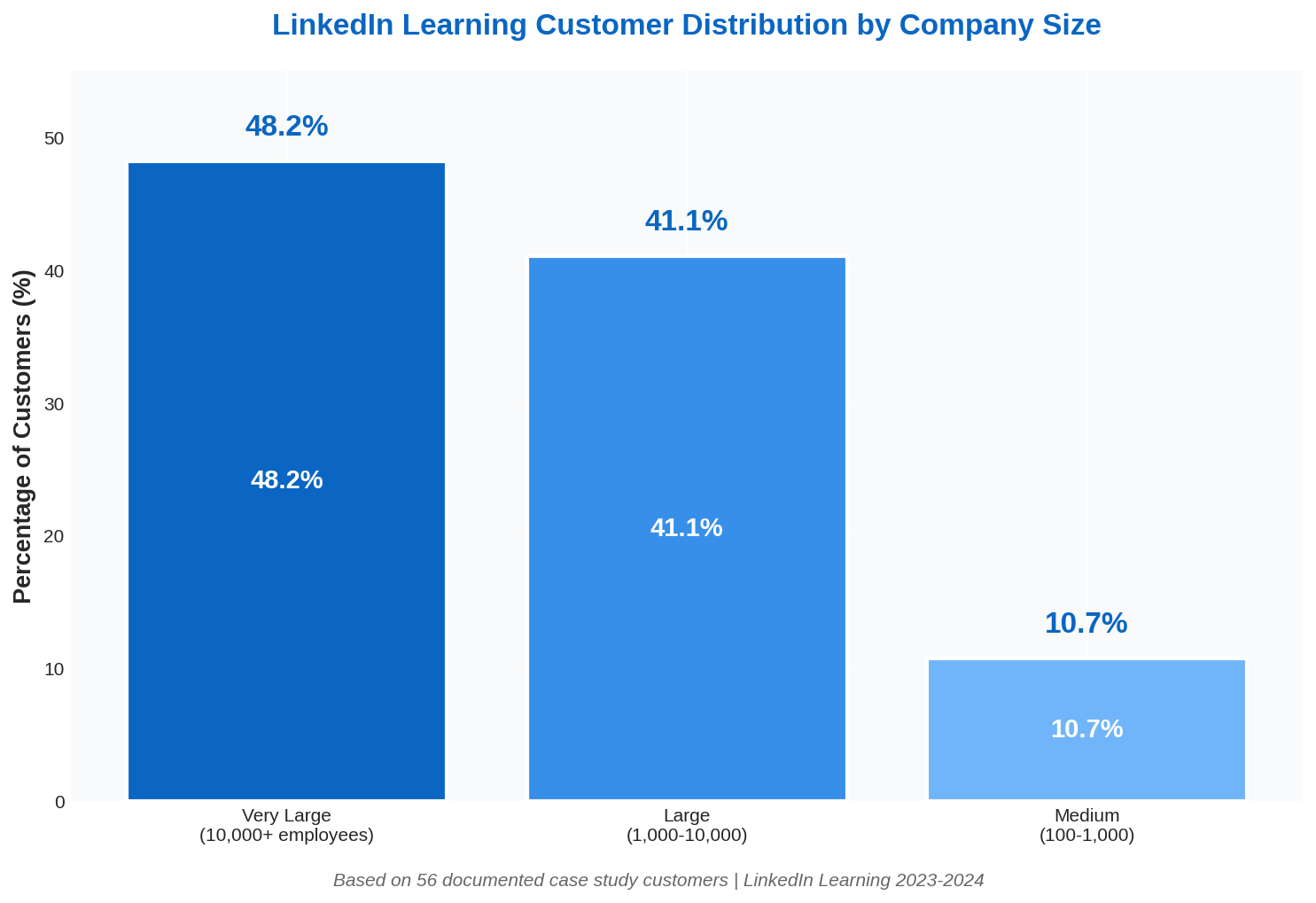
By company size: Very large enterprises with 10,000+ employees represent roughly 48% of documented customers—we're talking global tech companies, multinational financial institutions, large healthcare systems, major universities.
Large organizations with 1,000-10,000 employees account for about 41%—regional enterprises, mid-sized universities, established companies across sectors. Medium-sized companies with 100-1,000 employees comprise around 11%, showing the platform can scale for growing businesses. But the sweet spot? Clearly enterprise.
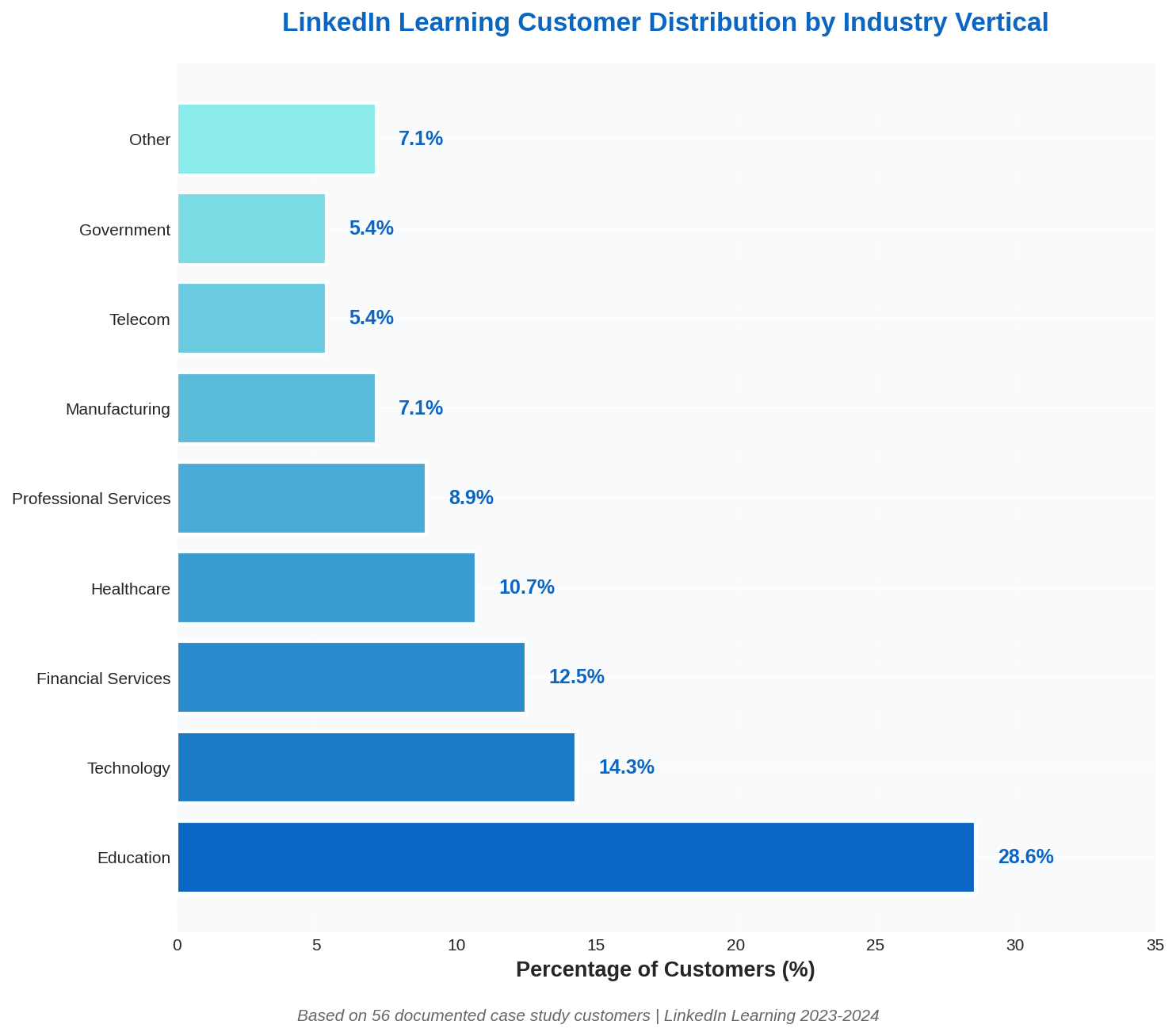
By industry vertical: Education leads with 16 organizations, including universities globally (Curtin University, Durham University, IE University, Macquarie University, and others). Makes sense—academic institutions need to develop both students and faculty.
Tech companies (8 organizations) include Accenture, Autodesk, Derivco, and various software firms seeking technical upskilling. Financial services (7 organizations) spans banks, investment firms, and insurance companies with compliance and professional development needs. Healthcare (6 organizations) includes Children's Healthcare of Atlanta and medical institutions balancing clinical and administrative training. Professional services (5), manufacturing (4), telecommunications (3), and government (3) round it out, with additional presence in energy, retail, automotive, and other sectors.
Geographic distribution: Deployments span North America (US, Canada), Europe (UK, Germany, France, Spain, Netherlands, Switzerland), Asia Pacific (Australia, Singapore, India, Pakistan, China, Japan), Middle East (UAE), Africa (South Africa, Kenya), and Latin America.
The 7 native languages with full audio localization (English, French, German, Spanish, Portuguese, Japanese, Mandarin) plus 46 subtitle languages make this genuinely global. Aboitiz Equity Ventures (Philippines), Bank OCBC NISP (Indonesia), and Telenor Group (Asian markets) show successful Asia Pacific implementations.
Deployment patterns and success factors: What separates successful deployments from mediocre ones? Executive sponsorship tops the list. Strategic change management. Content curation aligned with business priorities. Integration with broader talent development initiatives.
When these pieces come together, activation rates run 70-100% in initial deployment periods, with monthly repeat learner rates around 40-83%. Derivco hit 100% activation with 60% staying active. LEGO Group reached 90% active users by embedding learning into company culture. The common thread? Treating it as a strategic talent development platform instead of just a content library.
LinkedIn Learning Solutions Customer wins, Customer success stories, Case studies
Pangram Labs - AI Detection - Medium
LinkedIn carries 62% of flagged AI content, Pangram data shows
Valparaiso University - Education
University of Brighton - Education
University of the West of England - Education
Zillow Group - Real Estate
University of the West of England (UWE Bristol) - Education
Competitive landscape: how LinkedIn Learning stacks up
The enterprise learning market is crowded. Udemy for Business, Coursera for Business, Pluralsight, Skillsoft, Degreed—they're all fighting for the same budget. So what makes LinkedIn Learning different?
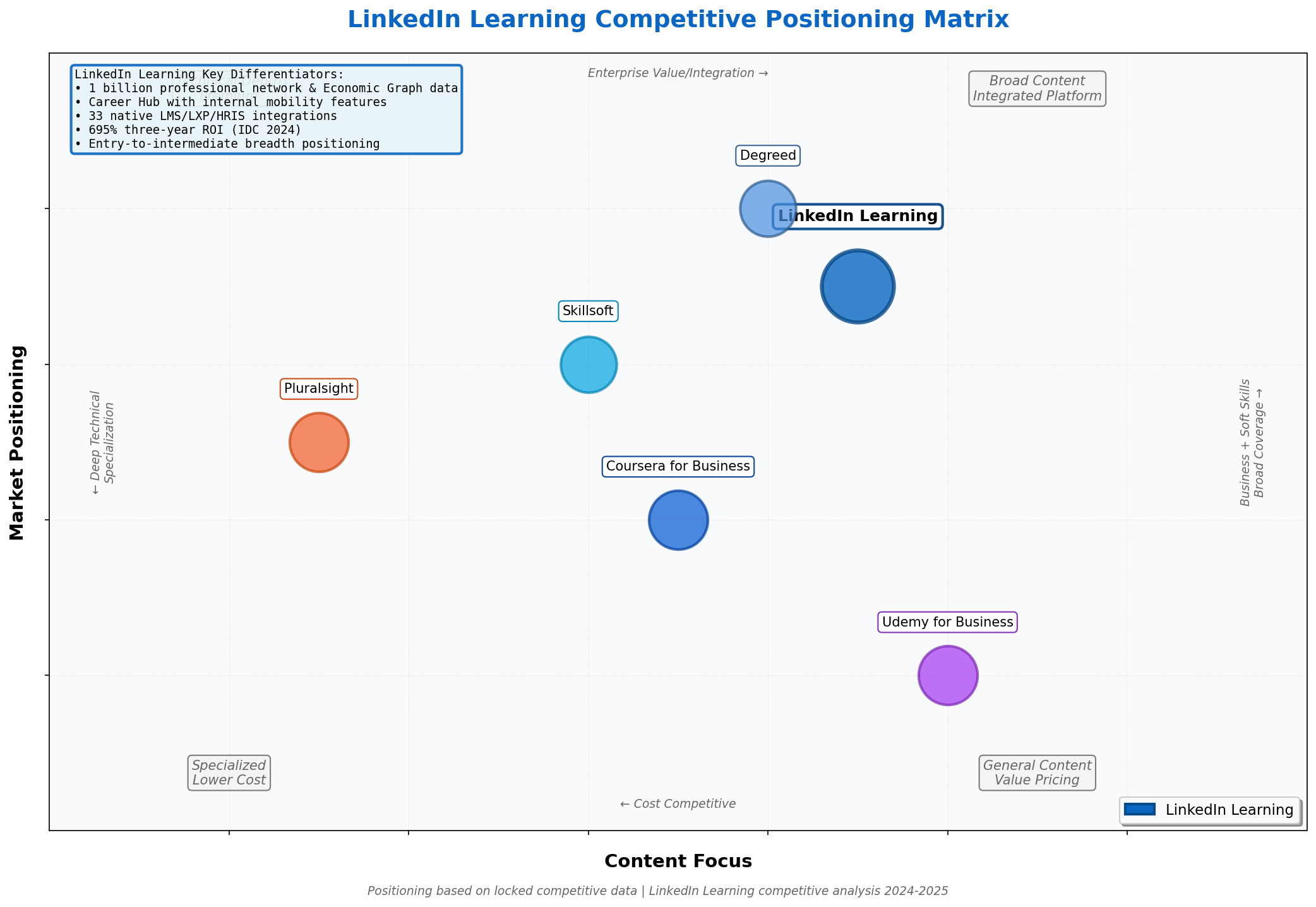
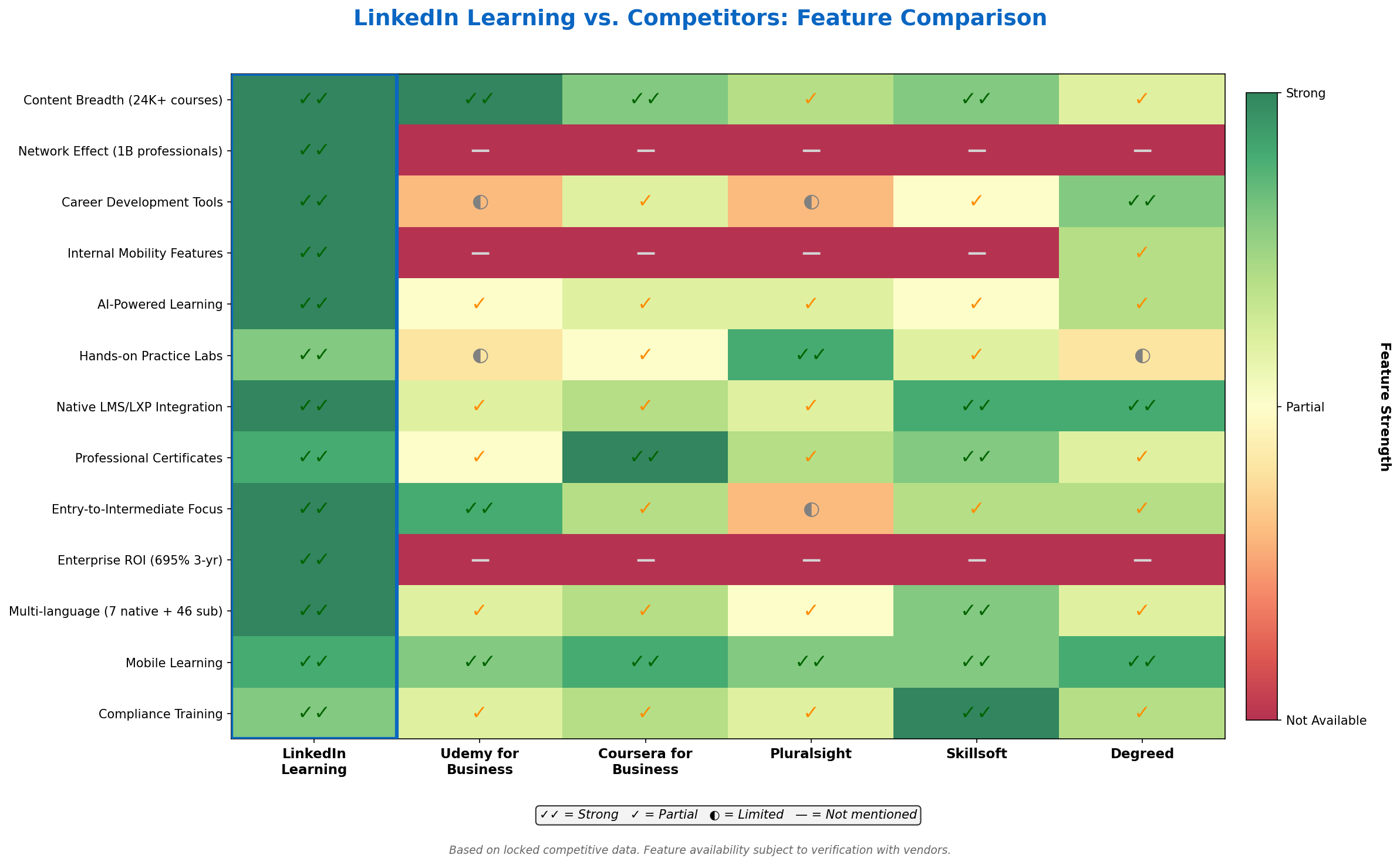
The network effect advantage: This is the big one. LinkedIn Learning sits on top of LinkedIn's 1 billion professional network. That means real-time labor market insights. Trending skills data. Career pathways based on what people actually do, not what textbooks say.
When you complete a course, it shows up on your LinkedIn profile—which, it turns out, really motivates people to finish. Standalone platforms can't replicate this because they don't have the underlying professional network.
Career Hub and internal mobility: Most learning platforms stop at course completion. LinkedIn Learning connects learning directly to internal job opportunities through Career Hub. Employees can explore career paths, build development plans, and see open roles that match their growing skills.
Companies see roughly 1% more internal promotions, with active users 3x more likely to move internally. That's not just learning—that's talent retention.
Content positioning: breadth over depth: Pluralsight goes deep on technical skills. Coursera focuses on university partnerships and academic credentials. Udemy Business offers volume at lower price points. LinkedIn Learning? It sits in the "broad coverage, entry-to-intermediate depth" space.
Over 24,000 courses across business, technology, and creative skills. But here's the trade-off—you're not getting the advanced technical depth of Pluralsight or the academic rigor of Coursera. You're getting breadth that works for most enterprise upskilling needs.
Integration ecosystem: With 33 documented partner integrations, LinkedIn Learning fits into existing tech stacks without forcing platform switches. Workday, SAP SuccessFactors, Cornerstone, Microsoft 365—these are deep, native integrations, not just API connections.
Degreed and EdCast position as learning experience platforms that can aggregate multiple content sources, including LinkedIn Learning. It's a complex ecosystem where partnership and competition overlap.
Pricing and ROI positioning: LinkedIn Learning isn't competing on price. Udemy Business typically comes in lower. But the validated ROI data—that 695% three-year return with roughly $830,000 annual value per 1,000 employees—positions it as a premium option justified by measurable business outcomes. IDC's research gives this credibility that vendor-generated numbers wouldn't have.
Where competitors have advantages: Let's be honest about where others win. Pluralsight beats LinkedIn Learning on technical depth for advanced developers. Coursera for Business offers stronger academic credentials and university partnerships. Skillsoft has deeper compliance and regulatory training. Udemy Business provides more content at lower cost. Degreed offers more sophisticated skills tracking and career planning tools.
The question isn't "which is best"—it's "which fits your specific needs."
Integrations and partner ecosystem: Connect your stack with LinkedIn Learning Solutions™
LinkedIn Learning connects to 33 documented partners across learning management systems (LMS), learning experience platforms (LXP), HR systems, collaboration tools, and specialized practice environments. Most companies deploy it as a content provider within their existing tech ecosystem—you're not ripping and replacing, you're adding.
Integration approaches vary from native connectors to API-based implementations, with most partners supporting automated user provisioning, content delivery, completion tracking, and reporting sync.
Learning management systems (LMS) and learning experience platforms (LXP): Major partners include Cornerstone OnDemand, Workday Learning, SAP SuccessFactors, Oracle Learning Cloud, Docebo, Degreed, 360Learning, Adobe Captivate Prime, Absorb LMS, Tovuti LMS, Moodle, Canvas LMS, Blackboard Learn, TalentLMS, LearnUpon, Litmos, SumTotal, Skillsoft Percipio, Saba Cloud, Bridge, iSpring Learn, Edcast by Cornerstone, and Fuse Universal. These integrations let you maintain existing LMS workflows while accessing content through familiar interfaces.
HR information systems and identity providers: Connects to Workday HCM, SAP SuccessFactors Employee Central, Oracle HCM Cloud, ADP Workforce Now, BambooHR, Namely, Okta, Azure Active Directory, and OneLogin. These connections enable automated user provisioning, role-based access control, and organizational hierarchy sync—reducing admin overhead and ensuring accurate learner populations.
Collaboration and productivity tools: Native Microsoft Teams and Microsoft 365 integrations mean you can assign learning, track progress, and access courses without leaving your workflow. Slack integration works similarly. These aren't just "nice to have"—they're about meeting people where they already work.
Technology practice partners: GitHub Codespaces integration provides real coding environments for hands-on practice. GitHub Code Challenges offer roughly 2,000 interactive exercises. Hack The Box delivers immersive Cybersecurity Training Labs. These aren't just watching videos—they're actual skill-building in production-like environments.
Content partnerships and aggregation: Here's something interesting—LinkedIn Learning operates as both a content creator and content aggregator. It partners with leading online learning providers to expand course offerings beyond proprietary content.
Content partnerships include Pluralsight (technical skills), Coursera for Business (university content), O'Reilly (tech and business expertise), Udemy Business (on-demand courses), Harvard Business Publishing (leadership), edX (Harvard, MIT, and other university courses), Codecademy (interactive coding), Udacity (job-ready digital skills), Skillshare (creative and professional development), OpenSesame (multilingual elearning), getAbstract (business book summaries), and GlobeSmart (global collaboration training).
This aggregation model is what distinguishes the approach—you're getting proprietary LinkedIn content plus curated third-party content from specialized providers through a single platform and licensing relationship. But here's where it gets complex: several content partners (Pluralsight, Coursera, Udemy Business, O'Reilly) also compete directly as standalone enterprise learning platforms. It's partnership and competition at the same time—welcome to the modern learning market.
Integration implementation: How do these actually get set up? Most involve SSO configuration, user provisioning via SCIM or CSV, content catalog integration, and xAPI or SCORM for completion tracking.
Setup time varies—simple SSO might take a few days, while full HRIS integration with custom reporting could take weeks. The good news? Most partners have well-documented processes and LinkedIn provides implementation support.
LinkedIn Learning Solutions integrates with a wide range of software applications through its robust data import and export capabilities.
Few API Integrations for LinkedIn Learning Solutions




Enterprise readiness: Security, compliance, integrations, migration and support
Security you can actually trust: LinkedIn Learning runs on LinkedIn's enterprise infrastructure with SOC 2 Type II attestation and ISO 27001 certification. It's deployed in regulated industries—banking, healthcare, government.
Bank OCBC NISP rolled it out across banking operations. Children's Healthcare of Atlanta implemented it within healthcare compliance requirements. For current certification docs, check with LinkedIn sales.
Compliance including privacy: GDPR compliant for European data protection. Works in heavily regulated sectors—financial services, healthcare, government. Professional development credits and continuing education units (CEUs) are recognized by SHRM, PMI, NASBA, and HRCI.
Professional certificate programs partner with Microsoft, Adobe, Atlassian, Zendesk, ServiceNow, and GitHub. Certification prep covers CompTIA, Oracle, IIBA, DevOps Institute, and more.
Successful regulatory deployments include City of Bloomington and State of Nebraska (government), plus Allianz operating under GDPR.
Integrations that actually work: Deep integrations with major LMS and LXP platforms mean it fits into your existing ecosystem. Content delivery, HRIS user management, reporting—it all syncs. Partners include Cornerstone, Workday, SAP SuccessFactors, Oracle, Docebo, Degreed, 360Learning, Adobe Captivate Prime, and Absorb.
AW Rostamani Group integrated with enterprise systems for seamless provisioning and tracking across automotive, real estate, and retail operations.
Migration stories: Switching from other vendors? It's typically smoother than expected. Alliance Data Systems migrated from Lynda.com and gained better mobile access, improved discovery, and deeper LinkedIn integration.
Companies moving from classroom training find the interface surprisingly user-friendly. Multiple case studies show 70-100% activation within initial deployment—that's pretty good adoption for enterprise software.
Customer support: Support comes through the Customer Success Center and dedicated sales specialists. Autodesk got responsive support during implementation with change management guidance. Onboarding includes strategic planning sessions. For SLA details and support tiers, talk with LinkedIn sales—enterprise-scale implementations often get dedicated account management.
Pricing and licensing: what it actually costs
LinkedIn Learning offers three main licensing tiers, but exact pricing isn't publicly listed—you'll need to talk with sales for quotes specific to your user count and requirements. Here's what each tier includes and who it's designed for.
LinkedIn Learning Standard License: This is the core offering. Access to 24,000+ courses across business, tech, and creative skills. AI-powered personalization. Mobile apps with offline viewing. LinkedIn profile integration. Native integrations with major LMS and HRIS platforms. Analytics and admin tools for tracking engagement and completions. Multi-language support with 7 native languages plus 46 subtitle languages. Most organizations start here—it covers fundamental enterprise learning needs at the most accessible price point.
LinkedIn Learning with Career Hub: Everything in Standard, plus Career Hub for internal talent mobility. This adds career exploration tools, development planning, internal job matching, and skills-based career pathways.
It's the tier that connects learning directly to career progression and internal mobility. Companies focused on retention and internal talent development typically go for this—the ROI comes from reduced external hiring costs (roughly $91,000 annually per 1,000 users according to IDC). Users with Career Hub access learn 5x more and engage 2x longer than those without it.
LinkedIn Learning Enterprise: The full package. Everything in Career Hub, plus enterprise-grade support, dedicated customer success management, strategic planning sessions, custom content capabilities, advanced analytics, and priority access to new features.
This tier is for large-scale deployments (typically 5,000+ users) where you need dedicated account management and strategic implementation support. Organizations like Autodesk and LEGO Group operate at this level.
Pricing factors and negotiation: Pricing typically scales with user count, but volume discounts kick in at higher tiers. Annual contracts are standard, with multi-year deals often getting better rates. Your existing LinkedIn relationship (if you're using Recruiter or Sales Navigator) might influence pricing. Integration requirements, custom content needs, and support levels all factor in.
For context, IDC's research valued the platform cost at roughly $51 per user annually—but that's likely for larger deployments with volume pricing.
Total cost of ownership: Don't forget implementation costs. SSO and basic LMS integration might take a few days of IT time. Full HRIS integration with custom reporting could take weeks. Change management and communication aren't free—budget for internal resources to drive adoption. Content curation if you're building custom learning paths. Ongoing administration and reporting.
But here's the flip side—IDC found companies saved roughly $109,000 annually per 1,000 users through vendor consolidation, reducing the total learning platform spend by about 57%.
Free trials and pilots: LinkedIn typically offers trial periods for evaluation. These vary by deal size and circumstances, but expect 30-90 day pilots for serious enterprise considerations. Use this time to test actual content relevance, integration complexity, and user adoption potential—don't just count courses.
| Tier | Who it's for | What you get |
|---|---|---|
| Individual/Small Team (≤20 learners) | Individual learners and small teams needing comprehensive content with basic dashboards | Per-user subscription; unlimited access to 22,000+ courses |
| LinkedIn Learning (Enterprise) | Organizations developing critical skills at scale for continuous workforce learning | Per-user licensing; 24,000+ courses, AI-powered features, LMS/LXP integrations, hands-on practice, professional certificates |
| LinkedIn Learning Career Hub | Organizations focused on strategic talent management, connecting learning to careers and internal opportunities | Per-user licensing with talent architecture module; includes everything in Enterprise plus career development, internal mobility, AI-powered learning plans, trending skills insights |
Note: Pricing details vary by volume and needs. Contact LinkedIn sales for current pricing, volume discounts, and enterprise licensing options. IDC's 2024 analysis found companies spending around $830,000 per 1,000 users annually—with that 695% three-year ROI.
Return on investment and total cost of ownership
The ROI breakdown (validated by IDC in 2024): Companies achieve roughly 695% three-year ROI with a two-month payback. That's $8 in benefits for every dollar spent. The annual value? Around $1.72M per organization (or about $830K per 1,000 employees).
Where does this value come from?
- ▸ Around $316,000 from higher revenue (roughly 0.9% increase)
- ▸ About $263,000 from productivity gains (3% improvement—equivalent to one extra productive week per employee annually)
- ▸ Approximately $109,000 in platform cost savings through vendor consolidation
- ▸ Around $91,000 in avoided external hiring costs (companies see roughly 1% more internal promotions)
- ▸ About $51,000 in reduced travel expenses from digital-first delivery
Customer evidence shows 20-50% faster onboarding time-to-productivity. When Aboitiz Equity Ventures proved the initial value, they planned a 5x license increase—that's what happens when ROI is demonstrable.
Competitive pricing positioning: Companies report LinkedIn Learning delivers solid value relative to cost, especially when consolidating multiple training vendors. That 57% reduction in total learning costs combined with 15% more people actually using learning? That's the sweet spot.
IDC studied companies averaging roughly 2,600 employees with around $481M revenue. Activation rates? About 79%. Courses completed? 3+ per employee annually. Those metrics indicate strong engagement relative to platform investment.
LinkedIn Corporation News
LinkedIn links app usage to profiles for over 1 million members
LinkedIn has expanded its connected apps feature, allowing members to link third-party software like HubSpot and GitHub to their profiles. This integration generates dynamic, non-editable descriptions of real usage activity, enhancing profile credibility. Over one million members have already activated this feature, which aims to provide verifiable proof of tool proficiency.
Adobe & LinkedIn launch AI skills initiative for marketing ...
Adobe and LinkedIn have launched "AI Essentials for Marketers," a global initiative to enhance AI skills among marketing professionals. The program offers role-based courses in 47 languages, leveraging LinkedIn Learning and Adobe Digital Academy. It aims to equip marketers with AI literacy and practical skills in digital marketing, content creation, and data analytics.
Visibility builds credibility — the tools you use every day, now visible on your LinkedIn profile
LinkedIn has expanded its platform to allow users to connect and showcase their expertise with various apps directly on their profiles. This integration with apps like HubSpot and Duolingo enables dynamic, real-time updates of users' skills, enhancing visibility and credibility for both users and app brands.
LinkedIn extends tools to creators
LinkedIn has launched Creator Marketplace and BrandWorks to enhance collaboration between brands and creators. Creator Marketplace centralizes tools for brands to find and partner with creators, while BrandWorks offers strategic support for B2B campaigns. These tools aim to increase credibility and engagement with decision-makers by leveraging creator influence and insights.
LinkedIn Corporation Profile
HQ Location
2029 Stierlin Ct. Ste. 200 Mountain View, CA 94043
Employees
1001-5000
Social


Financials
PRIVATE