


Alation Agentic Data Intelligence Platform: Data Governance Solutions overview — capabilities, features, use cases and value by role
Alation Agentic Data Intelligence Platform pulls cataloging, governance, lineage, and data quality into one integrated hub. It sits within the Data Governance Solutions and Data and Analytics Governance Platforms categories, built for organizations that need to find, understand, and trust their data across business systems.
Top capabilities of Alation Agentic Data Intelligence Platform
Data Governance
Read detailsThe Alation Agentic Data Intelligence Platform delivers data governance by centralizing policies, automating stewardship workflows, and maintaining end-to-end data lineage. It applies row-level access controls and dynamic masking. The platform's toolset includes Trust Flags, Policy Center, Catalog Sets, and Workflow Automation. Alation also surfaces trusted data for model training and helps teams stay compliant. Customers describe concrete results. As Alkermes puts it, "Alation has become a trusted partner for our business. It is really helping us take data literacy and data governance to the next level." Allegro SPA confirms, "We were definitely able to establish comprehensive data governance."
Data Catalog
Read detailsThe Alation Data Catalog gives teams a single place to find, understand, and trust data — connecting metadata from 120+ pre-built connectors across data sources, BI systems, and file systems. Teams can search in natural language, visualize lineage, apply trust flags, and add collaborative annotations. As Alkermes puts it, "Alation has evolved from a simple data catalog to a comprehensive data intelligence platform for Alkermes." Allegro SPA puts the practical benefit plainly: "We expect the data catalog to significantly accelerate the process of creating analyses, reports, models, and data products by reducing the complexity of the data search process." Within the Alation Agentic Data Intelligence Platform, the catalog auto-extracts and integrates metadata into a data fabric. Workflow automation then keeps metadata quality, consistency, and compliance in check across the organization.
Analytics
Read detailsAlation Analytics tracks data maturity across metrics — total assets curated, active users, top queries, platform adoption, and ROI — within the Alation Agentic Data Intelligence Platform. A built-in natural-language "Chat with Alation Analytics" feature lets users query certified data products without writing SQL. The platform also provides a framework to articulate the business value of data initiatives, with documented outcomes including $4.9M ROI. HBF Health Ltd. notes, "Our cloud analytics stack works exceptionally well as an ecosystem, and we intend to use Alation to catalogue all that good data for analytics." VillageCare adds, "The analytics team is 100 percent confident. They're solid on where the data came from and what they're doing with it."
Data Lineage
Read detailsAlation Data Lineage traces how data flows from source to destination, combining automated metadata extraction, SQL log analysis, and a proprietary query-parsing engine to produce near real-time lineage graphs. Users can toggle overlays for data quality, trust flags, and business metadata. Impact analysis helps prevent costly outages and supports compliance audits. Judo Bank highlights Automated Data Lineage among the platform's strengths, alongside Mature data governance capabilities and Customisable templates to meet specific customer needs.
Business Glossary
Read detailsThe Business Glossary within Alation Agentic Data Intelligence Platform standardizes business terms, metric definitions, and KPIs across the organization, making them searchable and linkable to data assets to support self-service access and consistent decision-making — with Blockdaemon pointing to - Business Glossary - Search feature - Data source management as standout capabilities.
Search & Discovery
Read detailsAlation's Search & Discovery puts a single AI-driven search bar at the center of enterprise-wide data discovery inside the Alation Agentic Data Intelligence Platform. It combines semantic, behavioral, and keyword ranking to interpret natural language queries and surface the most relevant, trusted data assets. Results can be filtered by domain, custom tags, object type, or data quality indicators. The experience also personalizes based on user behavior and usage patterns.
Data Products Marketplace
Read detailsThe Alation Data Products Marketplace brings together build, certify, discover, and consume workflows in a single self-service hub. It enforces quality, ownership, and compliance standards at scale. Access is gated through request-and-approval workflows, and users can query data products in natural language through a metadata-aware agent.
CDE Manager
Read detailsCDE Manager, part of the Alation Agentic Data Intelligence Platform, automates Critical Data Element governance by using AI agents to connect policies, glossary terms, and data lineage in one audit-ready system of record — achieving 70% reduction in CDE governance costs and 7 days average time savings per CDE onboarded.
Agent Studio
Read detailsAgent Studio, part of the Alation Agentic Data Intelligence Platform, lets organizations custom-build governed AI agents through an SDK, no-code templates, or a guided flow, connecting to 100+ data sources and deploying via MCP or REST APIs — with agents grounded in the Agentic Knowledge Layer (Data Catalog and Data Products), inheriting access controls and governance policies, and validated through built-in evaluations and Q&A sets to reach greater than 90% accuracy before production.
Workflow Automation
Read detailsAlation Workflow Automation automates repetitive data governance tasks across metadata quality checks, security classification, compliance enforcement, and curation alerts. It uses pre-built templates, rules, and APIs alongside a low-code builder for multi-step workflows with approvers and object scopes. The feature integrates with tools such as ServiceNow, Jira, Slack, Microsoft Teams, BigID, and Immuta, all within the Alation Agentic Data Intelligence Platform.
ALLIE AI
Read detailsALLIE AI is the AI and machine learning layer built into Alation that automates catalog curation and scales data initiatives across an organization. The Behavior Analysis Engine drives that automation, reducing the manual effort required to keep the catalog current. Intelligent Search, Suggested Descriptions and Titles, and GenAI-powered productivity assistance all build on that same foundation, broadening access to trusted enterprise data without requiring constant human intervention.
Documentation Agent
Read detailsThe Documentation Agent in the Alation Agentic Data Intelligence Platform automatically translates technical metadata — table names, columns, data types, and lineage — into clear business language. It connects to data sources via secure APIs, scans metadata automatically, and can ingest existing content such as readme files to link to relevant data assets. Suggested descriptions can then be approved or refined by users. In complex industries, up to 94% of time is spent preparing data for analytics and AI, and integrating AI into data management can boost productivity by over 50% for critical manual tasks.
Data Quality Agent
Read detailsThe Data Quality Agent within the Alation Agentic Data Intelligence Platform uses agentic AI and metadata to surface and monitor high-impact data assets. It automatically suggests and applies tailored quality rules, then resolves issues in context within the Alation Data Catalog. Behavioral analysis of query patterns and usage signals drives prioritization, and resolution integrates into daily workflows through Slack, Teams, email, or BI tools — a meaningful consideration given that over 25% of organizations lose more than $5 million annually due to poor data quality.
Data Products Builder Agent
Read detailsThe Data Products Builder Agent turns raw data assets into governed, versioned data products — without requiring anyone to write code. It is part of the Alation Agentic Data Intelligence Platform. The agent uses AI to recommend, auto-identify, and document data assets, then packages them according to the Open Data Products Specification (ODPS). Data teams can certify those assets as AI-ready and publish them to a governed Data Products Marketplace. Companies that treat data like a product can reduce implementation time in new use cases by as much as 90%, and those with data products see an 8.7x higher improvement in innovation metrics versus those without.
Chat with Your Data
Read detailsAlation Chat with Your Data lets business users query enterprise data in plain English, with AI agents writing SQL or Python behind the scenes to return answers with 60% more accuracy from metadata-aware agents. Every response surfaces the underlying SQL, source data, and business definitions. Governance, access controls, and role-based permissions are enforced automatically through the Alation Agentic Data Intelligence Platform's knowledge layer of trusted data products.
Data Quality Monitoring
Read detailsData Quality Monitoring, part of the Alation Agentic Data Intelligence Platform, connects best-of-breed DQ and observability tools to a unified view. It shares quality details natively with Databricks, Snowflake, and other platforms. Quality health is then overlaid directly on lineage diagrams, giving teams a complete picture without leaving Alation.
Alation Curation Automation
Read detailsAlation Curation Automation, part of the Alation Agentic Data Intelligence Platform, allows governance teams to declare metadata standards once in natural language and have purpose-built AI agents enforce them continuously — enriching titles, descriptions, classifications, PII tags, and steward assignments at scale, with every suggestion previewable before execution, existing values preserved by default, and all actions fully auditable for regulated environments.
automated metadata extraction
Read detailsAlation Agentic Data Intelligence Platform extracts table names, columns, data types, lineage, and query logs from connected data sources automatically — no manual effort required. The platform catalogs this information as it is pulled in. Oportun applied this capability alongside data profiling and query log ingestion during a migration to AWS Redshift and AWS S3.
query log ingestion
Read detailsQuery log ingestion in the Alation Agentic Data Intelligence Platform continuously pulls SQL query logs from connected data sources. Natural-language parsing and pattern recognition then infer table- and column-level transformations, populating lineage graphs automatically. At Oportun, this capability worked alongside automated metadata extraction and data profiling to catalog metadata as data migrated to AWS.
automating stewardship
Read detailsAlation Agentic Data Intelligence Platform replaces manual, fragmented governance with a continuous, automated system. It centralizes policies and enforces access, masking, and approvals across the data estate. Agentic workflows then handle documentation, policy enforcement, and data product delivery automatically.
MCP deployment
Read detailsAlation Agent Studio supports deploying AI agents into external applications and workflows through MCP (Model Context Protocol) or REST APIs. Agents connect to 100+ data sources including Snowflake, Databricks, Tableau, and Power BI. They can be embedded across enterprise stacks without vendor lock-in, and built-in evaluations and custom judges help achieve greater than 90% accuracy before deployment.
Top features of Alation Agentic Data Intelligence Platform
Alation Compose
Read detailsAlation Compose is an intelligent, web-based SQL editor integrated with the Alation data catalog, offering real-time color-coding for data quality, popularity-based recommendations, cataloged-schema autocomplete, and self-serve SQL forms for business users. As US Federal Government Agency puts it, "Compose was a huge differentiator between Alation and other data catalogs that didn't have the ability to write SQL code and query data within the tool." Oportun saw a 150% increase in Compose query executions within ten months, and its top ten Compose users have authored more than 3,200 queries. VillageCare reached 4.4K average monthly Compose queries alongside a 254% rise in overall Alation usage.
APIs
Read detailsAlation APIs give organizations a programmatic way to connect external applications and systems to the Alation Agentic Data Intelligence Platform. Teams can transfer information such as glossaries and documents in bulk. They can also automate data pipeline and product deployment workflows. Code examples and how-to guides are provided for common tasks like adding tags to columns.
Open Data Quality Framework
Read detailsThe Open Data Quality Framework connects any vendor or in-house data quality tool to the Alation Agentic Data Intelligence Platform through an API-driven integration layer, surfacing quality metrics, lineage, and usage data directly in the catalog UI. Teams enable a Data Health tab via a public API, add custom fields for rule results, and tag assets with a 'Has Data Quality' picker so quality indicators appear where users search and work.
Alation Anywhere
Read detailsAlation Anywhere brings data intelligence into the daily tools users already work in, including Google Chrome, Microsoft Teams, Slack, and Tableau. It surfaces metadata details, data quality flags, and searchable business glossary terms in context. It also delivers real-time, side-by-side metadata previews of data assets from sources such as Snowflake Snowsight, PowerBI, and Looker directly within productivity apps.
Alation AI Agent SDK
Read detailsThe Alation AI Agent SDK is a developer toolkit that standardizes connections between data sources and tools, enabling developers and third-party partners to build AI agents that draw on Alation's trusted metadata context for accurate reasoning, governance automation, and natural language querying — a space where 40% of CDOs cite 'Supporting AI' as their #1 strategic objective. The SDK ships with prebuilt components, integrations, governance enforcement APIs, and orchestration tools designed to reduce time-to-value and engineering costs.
Active Metadata Graph
Read detailsThe Alation Agentic Data Intelligence Platform centers its intelligence on the Active Metadata Graph. This feature ingests and processes database query logs to uncover behavioral insights on how data is used across the organization. It surfaces the most popular data assets, identifies subject-matter experts by asset based on actual usage, and automatically builds an interactive lineage graph from SQL join information.
Open Connectors Framework
Read detailsAlation's Open Connectors Framework reaches 120+ data sources through pre-built connectors, giving teams a single view across their entire data ecosystem. The framework handles metadata extraction, query log processing, data profiling, sampling, lineage, authentication, and SQL query execution. An included SDK extends that coverage to less common sources.
Top use cases for Alation Agentic Data Intelligence Platform
Metadata Management
Read detailsThe Alation Agentic Data Intelligence Platform helps data teams and analysts activate metadata across the data management ecosystem. It connects behavioral metadata from various sources and surfaces governed data in tools like Slack, Microsoft Teams, and Tableau through bi-directional connectors. End-to-end data lineage with impact analysis ties everything to a central business glossary, reducing data delivery time and powering the organization's data fabric.
Data Modernization
Read detailsAlation Agentic Data Intelligence Platform gives data teams a unified view of trusted data assets before a cloud migration begins — and keeps working after the migration is done. End-to-end data lineage and impact analysis let teams anticipate downstream dependencies before anything moves. Once the migration is complete, the platform continuously monitors data usage across cloud and on-premises environments. That ongoing monitoring drives performance optimization and cost reduction, enabling a faster return on investment.
Create a Data Governance Platform That Actually Work
Read detailsData governance program leaders and data stewards use the Alation Agentic Data Intelligence Platform to build a functioning governance program. That starts with setting a clear vision linked to business goals and cataloging high-value data assets. Automating classification and policy tagging frees stewards for higher-value work. Transparent policies then guide compliant data use across the organization. Teams drive collaboration, monitor progress, and continuously improve governance workflows to demonstrate policy conformance.
Outcome-Based Governance
Read detailsThrough CDE Manager, Curation Automation, and Alation Data Quality, the Alation Agentic Data Intelligence Platform lets governance teams declare standards once. Purpose-built AI agents then enforce, enrich, and validate metadata continuously across the data estate. The result replaces manual processes with an operating system that accelerates AI readiness, reduces compliance risk, and lowers governance operating costs.
AI Governance
Read detailsData and AI teams use Alation Agentic Data Intelligence Platform to establish a governed foundation for AI initiatives. Trusted datasets are surfaced through Intelligent Search, data quality feeding models is monitored continuously, and AI/ML assets are catalogued for traceability. Model information is documented to support compliance and explainability, with audit-ready data, transparent lineage, and enforced policies maintained across the full AI lifecycle.
Privacy, Risk, Compliance
Read detailsThe Alation Agentic Data Intelligence Platform handles data governance and compliance by automatically discovering and classifying sensitive data at scale. Policies are managed and enforced directly within the data catalog, so data consumers encounter guidance at the moment they need it — inside their natural workflow. Linking data to well-defined policies and applying role-based access keeps compliant use the path of least resistance. TrustFlags and TrustCheck add another layer, helping organizations reduce compliance risk under regulations such as GDPR and CCPA while building a privacy-aware data culture.
Simplify CPS 230 & CPG 235 Compliance
Read detailsThe Alation Agentic Data Intelligence Platform brings APRA CPS 230 and CPG 235 compliance work into a single, centralized system. It stores business definitions, lineage, and metadata together, so teams are not hunting across separate tools. Data is classified and tagged by criticality and sensitivity. Governance policies live directly inside the catalog rather than in external documents. Continuous monitoring keeps an audit trail current, supporting demonstrated regulatory alignment with APRA's data management standards.
Self Service Analytics
Read detailsAlation Agentic Data Intelligence Platform puts trusted data within reach of analysts and business stakeholders without requiring them to leave the tools they already work in. AI-driven semantic and behavioral search, over 120 connectors, and collaborative metadata enrichment all work together to make that self-service access possible. Governed data is reachable directly inside Microsoft Teams, Slack, Tableau, and Google Chrome. An Intelligent SQL editor accelerates query writing for data analysts, supporting faster and more confident business decisions.
Value delivered by role with Alation Agentic Data Intelligence Platform
data governance manager
Read detailsThe Alation Agentic Data Intelligence Platform gives data governance managers one place to handle cataloging, policy management, and collaboration together. That combination lets governance leaders give business stakeholders a clear assurance that data is available, governed, trustworthy, and protected.
business users
Read detailsAlation Agentic Data Intelligence Platform puts trusted data directly in the hands of business users through a self-service interface that requires no SQL expertise. Users can search for, understand, and verify the data they find on their own. Alation articles explain where data lives, what it means, and why it matters. Interactive SQL forms let non-technical users answer questions independently and collaborate more effectively with IT teams.
subject matter experts
Read detailsSubject matter experts and data owners rely on the Alation Agentic Data Intelligence Platform to document their knowledge in catalog articles, making that expertise available to anyone in the company who needs it. This means the same questions don't have to be answered over and over. Data owners spend less time on routine dataset maintenance as a result, which frees them to focus on optimizing the data portfolio and finding cost-saving opportunities.
data analysts
Read detailsData analysts using the Alation Agentic Data Intelligence Platform can find and use trusted, well-documented data on their own, without depending on colleagues. Search and discovery capabilities surface the best data for each use case. An intelligent SQL editor provides real-time quality warnings alongside code recommendations. Shared queries and knowledge articles speed up onboarding and encourage collaboration across the analyst community.
data engineers
Read detailsData engineers use Alation to decrease root cause analysis time in data pipelines via lineage with Trust Flags, and to access the metadata they need to generate pipelines and stay apprised of metadata changes. We have improved our data engineers' developer experience. They have more time to understand the data that they are provisioning instead of just being the plumbers who are moving data, as in the past.
data stewards
Read detailsAlation Agentic Data Intelligence Platform takes the manual grind out of data stewardship by automating classification, policy tagging, and data lineage. That automation lets stewards redirect their attention toward improving data quality and curating high-value data assets. Stewards also use the platform to collect, collate, and curate business metadata and definitions, keeping terminology consistent across the organization. Governance policies for protecting sensitive data are managed through the same platform. Stewards can validate AI-driven automation results there too, while defining business rules and handling edge cases.
chief data officer
Read detailsChief Data Officers use the Alation Agentic Data Intelligence Platform to unlock the strategic value of data. The platform's ease of use drives adoption across the enterprise, turning data into a competitive asset that improves the quality of business decisions. Its governance-first approach sets organizations up for long-term data success.
director of Commercial Data Strategy and Governance
Read detailsAlation Agentic Data Intelligence Platform lets Directors of Commercial Data Strategy and Governance capture data information ranging from basic table and column definitions to complex business rules and usage caveats. That documented knowledge supports better data-driven commercial decision-making. It also frees data subject matter experts from answering repetitive questions about data location and meaning, so they can focus instead on optimizing the data portfolio and identifying cost-saving opportunities.
general manager of data platforms
Read detailsAlation Agentic Data Intelligence Platform centralizes data asset management across business domains while enabling self-service data utilization and autonomous data discovery at scale. General Managers of Data Platforms rely on it to drive data-driven customer engagement. It also supports AI adoption across large organizations in a way that stays effective and appropriate.
developers
Read detailsAlation Agentic Data Intelligence Platform shortens project launch times from months to weeks by helping developers find and reuse existing datasets and reports rather than recreating them. Analysts can also trace legacy report logic, which means critical data migrations happen with confidence instead of guesswork.
data scientists
Read detailsData scientists use Alation to accelerate AI model development by quickly finding definitions, user rights, and lineage without manual searching, making Alation indispensable for understanding what features are available for machine learning model creation. By using Alation to certify data assets and Monte Carlo to demonstrate that those assets are being continuously monitored, my team can ensure that we're providing trustworthy data to the data science team for their AI models.
analytics leaders
Read detailsAlation Agentic Data Intelligence Platform brings analytics leaders, governance oversight, and company-wide collaboration into a single platform. A standard approach to processing, retrieving, archiving, and restoring data builds a solid foundation for enterprise data. That consistency helps reduce disparate datasets while supporting data-driven decision-making.
Analytics Manager
Read detailsAlation Agentic Data Intelligence Platform equips Analytics Managers with a built-in Compose SQL editor for querying data, paired with Alation University training that cuts onboarding time sharply enough that new users can be writing queries in less than an hour.
enterprise data architect
Read detailsFor enterprise data architects, Alation Agentic Data Intelligence Platform serves as the governance and cataloging foundation for managing data assets across the organization, shifting decision-making toward empirical, objective-based evidence.
Head of Data & Information Management
Read detailsFor Heads of Data & Information Management, the Alation Agentic Data Intelligence Platform addresses the challenge of different business units measuring key data differently. It provides a method to agree on, publish, and expose organizational definitions and metrics across the organization. Lineage capabilities also allow technical users and analysts to trace data connections back to their source.
IT and data management teams
Read detailsAlation Agentic Data Intelligence Platform takes routine data questions off IT and data management teams so they can focus on higher-value work. Its active metadata graph helps IT determine which data to migrate to the cloud first. Beyond IT, the broader organization can naturally incorporate data into everyday workflows to steer business decisions.
governance teams
Read detailsAlation Workflow Automation redirects governance teams from manual, repetitive metadata authoring toward validating outcomes. The focus moves to work that genuinely requires human judgment. Compliance teams gain provable enforcement with full auditability. Governance analysts get streamlined workflows that extract and format the information they need with minimal effort.
decision-makers
Read detailsAlation Agentic Data Intelligence Platform is built to help decision-makers reach data insights faster through self-service access to trustworthy, up-to-date information, backed by data quality and integrity assurances. As Oportun puts it, "Alation empowers data-savvy decision makers, analysts, and data consumers to find shared data for faster, more accurate insights."
vice president of data strategy, governance, and reporting
Read detailsAlation Agentic Data Intelligence Platform is built for VPs of data strategy, governance, and reporting who need governance infrastructure and data quality tools to maintain high accuracy standards across the organization for confident, data-driven decision-making.
Sr. Director, Enterprise Data Platforms
Read detailsAlation Agentic Data Intelligence Platform cuts the time data engineers spend on data discovery and metadata curation. That recovered time goes toward product innovations. Faster pipeline generation follows. So does sustained leadership in customer satisfaction.
senior manager of data quality and metrics
Read detailsFor data quality teams focused on AI readiness, the Alation Agentic Data Intelligence Platform supports senior managers in certifying data assets. It combines certification capabilities with continuous monitoring tools to ensure trustworthy data reaches data science teams for AI models, maintaining that standard at scale.
Director of IT Data Management
Read detailsFor Directors of IT Data Management working across complex ecosystems such as healthcare, Alation Agentic Data Intelligence Platform connects and manages data from disparate sources so teams can see and act on member data effectively. It begins delivering value in as little as three weeks. It also serves as a shared reference point in working meetings, enabling productive, data-driven collaboration.
Leader of Data and AI/ML Governance
Read detailsFor leaders of Data and AI/ML Governance, the Alation Agentic Data Intelligence Platform delivers the transparency, traceability, and governance needed to build, document, and validate analytical models confidently at scale. Data quality flags and lineage for AI auditability keep the AI model inventory accurate and timely. AI traceability features allow cataloging of AI/ML assets, covering datasets, notebooks, and vector databases, for stakeholders and auditors.
Marketing
Read detailsMarketing, Finance, and Sales teams can ask plain-language questions and get direct answers through Alation Agentic Data Intelligence Platform's Chat with Your Data feature, reaching self-service insights without dashboards or SQL skills.
What customers say about Alation Agentic Data Intelligence Platform: ratings, outcomes and feedback
Alation Agentic Data Intelligence Platform customers report their experience across two dimensions: what they value in day-to-day use and where they see room for improvement. Both dimensions reflect direct customer perspective on working with Alation across Data Governance Solutions and Data and Analytics Governance Platforms contexts.
What works well
Discover Financial Services says, "By improving the speed at which we are able to acquire and use data, we can turn that saved time into product innovations that help us remain No. 1 in customer satisfaction and delivering personalized customer experiences." HBF Health Ltd. puts the accuracy bar plainly: "The data must be as close to 100% accurate as we can possibly get." One customer notes that data producers who have documented a dataset well in Alation no longer have to answer the same question repeatedly. As Alkermes puts it, the platform's Google-like search engine lets people find, understand, and trust the data they are using.
Where customers see room for improvement
Alation Agentic Data Intelligence Platform draws recurring criticism around lineage depth, AI maturity, admin visibility, and support quality. Judo Bank flags Data quality capabilities a key vendor focus but not yet fully matured alongside Nascent (agentic) AI integration, signaling that two headline priorities are still works in progress. One enterprise customer points to Agentic driven uplift and the value of Integration with Github to extract code and allow better metadata as areas where more is expected. On lineage, only table level lineage is included as standard — column-level detail sits behind an additional payment. Admin oversight is another gap: what is lacking is a quick and easy way for an admin to monitor conversations, and built-in reporting doesn't surface unanswered questions without running custom queries. Term tables are not yet part of the Alation Analytics area, which makes managing term creation across business glossaries harder than it should be. Data mapping can be confusing, and customers note that connector issues arise, though Alation has been responsive in working through them. Support communication is flagged as needing improvement, with one customer noting it could have been raised earlier in the process.
Alation Customer wins, Case studies
Frequently Asked Questions (FAQ)
What buyers ask before choosing Alation
Integrations What CRM integrations are available for Alation?
Alation offers several CRM integrations that enhance its data intelligence capabilities, allowing businesses to leverage their customer data effectively. While specific CRM platforms are not explicitly mentioned in the provided context, Alation's technology partnerships typically include major players in the CRM space, such as Salesforce and HubSpot. These integrations enable users to connect their customer relationship management systems with Alation's data catalog, facilitating seamless access to trusted insights and improving decision-making processes. By integrating with CRM systems, Alation helps organizations streamline data governance, enhance self-service analytics, and drive better business outcomes through improved collaboration and data-driven strategies. For the most accurate and up-to-date information on specific CRM integrations, it is advisable to consult Alation's official resources or support documentation.
Integrations How does Alation connect with Salesforce and HubSpot?
Alation integrates seamlessly with Salesforce and HubSpot to enhance data-driven decision-making and streamline business processes. Through its robust integration capabilities, Alation allows users to connect their data intelligence platform with Salesforce, enabling teams to access trusted insights directly within their CRM workflows. This integration helps in understanding customer interactions and improving sales strategies. Similarly, by connecting with HubSpot, Alation facilitates the extraction of valuable marketing data, allowing users to analyze campaign performance and customer engagement effectively. Both integrations support Alation's mission to centralize knowledge about data, empowering users to make informed decisions while ensuring data governance and compliance. This interconnectedness ultimately drives better outcomes across sales and marketing initiatives.
Integrations What are the setup steps for integrating Alation with Snowflake?
To integrate Alation with Snowflake, begin by ensuring you have the necessary permissions and access to both platforms. First, set up your Snowflake account and create a dedicated database for Alation to store its metadata. Next, in Alation, navigate to the integration settings and select Snowflake as your data source. You will need to provide your Snowflake account details, including the account name, username, password, and the database name you created. Once the connection is established, configure the data ingestion settings to define which datasets you want Alation to catalog. Finally, run the initial data sync to populate Alation with metadata from Snowflake, allowing users to discover and utilize data effectively. Regularly monitor the integration to ensure data accuracy and governance.
Integrations Can Alation sync data with Marketo and what is the sync behavior?
Yes, Alation can sync data with Marketo, enabling organizations to enhance their marketing automation efforts through improved data intelligence. The sync behavior typically involves Alation capturing and cataloging data from Marketo, allowing users to access and understand their marketing assets more effectively. This integration facilitates the seamless flow of data, ensuring that marketing teams can leverage accurate and trusted insights for decision-making. Alation's capabilities, such as robust search functionalities and metadata-aware responses, enhance the clarity and governance of the data being synced. By integrating with Marketo, Alation not only streamlines data access but also promotes collaboration among teams, ultimately driving better marketing outcomes and supporting compliance initiatives.
Integrations What limitations should I be aware of when integrating Alation with data providers?
When integrating Alation with data providers, it's important to be aware of a few limitations. While Alation offers a robust Open Data Quality Framework that allows for seamless integration with various data quality solutions, the effectiveness of these integrations can depend on the compatibility of the data provider's systems and the specific configurations required. Additionally, users may encounter challenges related to data lineage visibility and quality metrics if the data provider does not support the necessary metadata standards. Furthermore, while Alation promotes collaborative insights, the success of these integrations often relies on the active participation of users in maintaining data quality and governance practices. Therefore, it's crucial to assess the capabilities of your data providers and ensure they align with Alation's integration requirements for optimal performance.
Integrations How does the data flow between Alation and other BI platforms like Tableau?
The data flow between Alation and BI platforms like Tableau is designed to enhance data accessibility and collaboration across organizations. Alation acts as a centralized knowledge hub, capturing data intelligence and providing robust search capabilities to help users quickly find trusted data assets. When integrated with Tableau, Alation enriches the data visualization process by allowing users to access and understand the context of their data through wiki-like articles and trust markers. This integration ensures that the data used in Tableau dashboards is not only reliable but also aligned with governance standards. As users interact with Tableau, they can leverage Alation's metadata-aware features to gain deeper insights, facilitating a seamless flow of information that transforms organizations from being data rich to data driven.
Features What does the Open Data Quality Framework do?
Alation's Open Data Quality Framework integrates data quality management into everyday workflows, enhancing the way organizations handle data. It provides users with direct access to quality metrics, data lineage, and usage statistics within the data catalog, allowing them to see data quality indicators precisely where they search and work. This framework enables teams to connect any vendor or in-house data quality solutions, ensuring they receive alerts only for issues that are relevant to them. Additionally, it fosters collaboration by allowing teams to work together on resolving data quality issues in a centralized location. By embedding data quality into daily operations, the Open Data Quality Framework helps organizations maintain high data standards, ultimately leading to better decision-making and improved business outcomes.
Features How do I configure the APIs for seamless integration in Alation?
To configure the APIs for seamless integration in Alation, start by accessing the Alation Data Intelligence Platform and navigating to the API documentation section. Here, you will find detailed guidelines on how to authenticate your API requests, including the necessary API keys and tokens. Next, identify the specific applications or systems you wish to integrate and review the available endpoints that correspond to those services. Use the provided examples to construct your API calls, ensuring you adhere to the required data formats and parameters. Once your API requests are set up, test them in a development environment to confirm they function as expected before deploying them in your production environment. This process will enable your organization to centralize data access and enhance collaboration across teams using Alation's robust data catalog capabilities.
Features What features does the AI Agent SDK provide for building secure AI applications?
The AI Agent SDK offers a robust set of features designed to facilitate the development of secure AI applications. It includes the Agentic Knowledge Layer, which provides trusted metadata to ensure that AI agents deliver precise, explainable, and auditable responses. This layer is crucial for maintaining compliance with regulations such as HIPAA, particularly in sensitive sectors like healthcare. Additionally, the SDK allows developers to achieve over 90% accuracy before production through built-in evaluations, Q&A pairs, and custom judges, ensuring that the AI applications are reliable and trustworthy. Developers can also customize their applications by selecting from various models like GPT, Claude, or Gemini, and can choose to build no-code solutions, making it accessible for a wide range of users while maintaining a focus on security and compliance.
Features How do I use the Workflow Automation feature to manage data governance?
To effectively use the Workflow Automation feature in Alation for managing data governance, start by identifying the specific governance tasks that require automation, such as data classification, approval processes, or compliance checks. Utilize the out-of-the-box workflows provided by Alation or customize your own using the low-code builder, which allows you to create multi-step processes tailored to your organization's needs. You can set up triggers for workflows, send alerts for important actions, and bulk-create requests to streamline operations. By automating these tasks, data stewards and governance teams can focus on strategic initiatives rather than manual, repetitive activities, ultimately enhancing the efficiency and effectiveness of your data governance framework.
Features What capabilities does Alation's search and discovery feature offer for data access?
Alation's search and discovery feature offers robust capabilities designed to enhance data access across organizations. It utilizes AI-powered semantic search, which goes beyond traditional keyword matching to interpret the meaning behind queries, ensuring users receive highly relevant results regardless of specific terminology. This intelligent search capability allows users to quickly find trusted data assets, supported by wiki-like articles, trust markers, and interactive discussions that provide context and clarity. Additionally, Alation enables users to filter and organize search results by domains, custom tags, object types, or data quality indicators, facilitating a more streamlined and efficient data discovery process. This democratization of data access empowers both technical and non-technical teams, including data analysts and business leaders, to make informed decisions based on reliable data.
Features How can I customize orchestration workflows in Alation for data management?
To customize orchestration workflows in Alation for data management, you can utilize the platform's low-code builder, which allows you to create tailored workflows that meet your specific needs. Start by accessing the workflow automation feature within the Alation Data Intelligence Platform. From there, you can define multi-step processes, set approvers, and specify object scopes relevant to your data governance tasks. Additionally, you can incorporate rule-based logic to route items for review, apply access controls, and curate metadata effectively. This customization not only enhances the precision and efficiency of your data management efforts but also ensures compliance with organizational standards, allowing your team to focus on strategic initiatives rather than repetitive tasks.
ROI & pricing What measurable business outcomes can Alation deliver for my organization?
Alation delivers measurable business outcomes by transforming how organizations leverage data and AI for decision-making. By utilizing Alation's AI-powered platform, businesses can achieve up to 60% more accurate insights through its metadata-aware agent, which enhances data governance and clarity. This leads to faster decision-making and improved operational efficiency, as teams can access trusted data quickly and easily. Additionally, Alation promotes self-service analytics, enabling users to find the most relevant data assets in seconds, which expedites cloud migration and simplifies data governance processes. With a proven track record among over 650 global organizations, including 40% of Fortune 100 companies, Alation not only drives regulatory compliance initiatives but also fosters a culture of collaborative insights, ultimately resulting in significant cost savings and enhanced business performance.
ROI & pricing How quickly can I expect to see a return on investment (ROI) after implementing Alation?
The return on investment (ROI) after implementing Alation can be realized quickly, often within a few months, depending on the specific use case and organizational context. Alation's platform is designed for easy deployment and includes over 120 pre-built connectors to various data sources and BI systems, which accelerates the integration process. Additionally, the Right Start program provides expert guidance tailored to your needs, ensuring that your team can effectively leverage Alation's capabilities for self-service analytics, cloud modernization, and data governance. By centralizing knowledge about your data and promoting collaborative insights, organizations can enhance decision-making and operational efficiency, leading to faster realization of business outcomes and ROI.
ROI & pricing What are the different pricing plans available for Alation, and what do they include?
Alation offers a range of pricing plans tailored to meet the diverse needs of organizations looking to harness their data effectively. While specific pricing details are not publicly disclosed, potential customers can request a quote through the Alation website by providing information such as company size and project timeline. Alation's plans typically include features like robust data search capabilities, trust markers, and interactive discussions to help users find and understand their most trusted data quickly. Additionally, Alation emphasizes self-service and guided implementation through its Right Start program, ensuring that businesses can leverage their data confidently. To explore the exact pricing options and what each plan includes, interested parties should fill out the request form on the Alation website for a personalized quote.
ROI & pricing How does Alation help in achieving cost savings for businesses?
Alation helps businesses achieve cost savings by streamlining data management and enhancing data accessibility, which reduces the time and resources spent on data-related tasks. With its robust search capabilities, users can quickly find and understand trusted data assets, minimizing the need for extensive training or reliance on specialized personnel. This self-service approach empowers employees to make informed decisions without waiting for IT support, leading to increased productivity. Additionally, Alation's collaborative features, such as interactive discussions and shared queries, foster communication among analysts, further accelerating insights and reducing duplication of efforts. By simplifying cloud migration and ensuring effective data governance, Alation not only lowers operational costs but also enhances compliance, ultimately driving better business outcomes and maximizing return on investment.
ROI & pricing What is the total cost of ownership for using Alation over time?
The total cost of ownership (TCO) for using Alation over time encompasses several factors, including initial licensing fees, ongoing subscription costs, implementation expenses, and potential training and support services. Alation offers various pricing plans tailored to different business sizes and needs, which can be explored directly on their website. Additionally, organizations should consider the costs associated with integrating Alation into existing systems, as it provides over 120 pre-built connectors to data sources and BI systems, facilitating seamless deployment. The TCO can also be influenced by the efficiency gains from improved data governance, expedited self-service analytics, and enhanced decision-making capabilities, ultimately leading to a faster return on investment (ROI) as businesses leverage trusted data insights more effectively.
ROI & pricing How long does it typically take to implement Alation and start realizing its benefits?
Implementing Alation typically allows organizations to start realizing benefits within a remarkably short timeframe. With the Right Start program, users can be up and running on Alation in as little as one hour, significantly reducing the onboarding time compared to traditional systems. This rapid deployment enables teams to quickly access trusted data insights, enhancing decision-making and accelerating the delivery of AI and business intelligence initiatives. Additionally, Alation's expert guidance throughout the implementation process ensures that organizations can effectively leverage its capabilities for self-service analytics, cloud modernization, and data governance. As a result, many users experience improved operational efficiency and faster return on investment shortly after deployment.
Capabilities What data governance capabilities does Alation offer?
Alation offers robust data governance capabilities designed to simplify the management of data assets while ensuring compliance and risk management. Through its Data Governance Policy Center, organizations can create and actively manage governance policies tailored to their specific needs. Alation promotes transparency and trust in data by providing features such as trust markers, wiki-like articles, and interactive discussions that help users understand the context and lineage of data assets. Additionally, Alation's integration with data quality platforms, like Anomalo, enhances its governance framework by ensuring that data remains reliable and compliant. This comprehensive approach not only expedites self-service data access but also supports organizations in achieving their data maturity goals, making Alation a trusted choice for enterprises looking to enhance their data governance practices.
Capabilities Can Alation support enterprise-scale data management?
Yes, Alation can effectively support enterprise-scale data management through its robust features and global support infrastructure. With 24/7 coverage and on-shore support in major regions, Alation ensures that organizations have access to expert assistance whenever needed, facilitating smooth operations across teams and continents. The platform empowers users at all levels—business users, analysts, and data stewards—with no-code tools for data governance, enabling them to manage data lineage and build data products collaboratively. Additionally, Alation's AI-powered capabilities enhance data intelligence, allowing enterprises to quickly find trusted data and insights, which is crucial for informed decision-making at scale. This combination of operational excellence and user empowerment makes Alation a strong choice for managing complex data environments in large organizations.
Capabilities Does Alation provide tools for measuring data maturity?
Yes, Alation provides tools for measuring data maturity through its Data Culture Maturity Assessment. This assessment is designed to help organizations evaluate their data culture by guiding users through a series of questions related to their data practices and maturity levels. Upon completion, participants receive a score along with feedback that highlights areas for improvement and growth. This structured approach not only helps organizations understand their current data maturity but also supports them in advancing their data capabilities, ultimately leading to better business outcomes. By leveraging Alation's tools, companies can foster a more data-driven culture and enhance their overall analytics capabilities.
Capabilities Can Alation help with compliance and risk management in data governance?
Yes, Alation can significantly aid in compliance and risk management within data governance. Its Data Governance Policy Center allows organizations to create and manage policies that actively address risk and compliance issues, ensuring that sensitive data is automatically discovered and classified at scale. Alation promotes a privacy-aware data culture by facilitating compliance with regulations such as GDPR and CCPA, linking data visibility to well-defined policies and implementing role-based access controls. Additionally, Alation's AI Governance suite enhances compliance by providing tools like an AI Asset Registry and compliance dashboards, which help organizations maintain ethical AI practices and ensure regulatory adherence. By leveraging these features, businesses can effectively manage risk while fostering a culture of accountability and transparency in their data governance efforts.
Capabilities What security features does Alation include to protect sensitive data?
Alation incorporates a range of robust security features to protect sensitive data, ensuring that information is safeguarded against loss, misuse, and unauthorized access. The platform employs state-of-the-art technical and organizational measures, including compliance with industry standards such as SOC 2 Type II, HIPAA/HITECH, and alignment with GDPR and CCPA regulations. Alation also prioritizes continuous monitoring and has a formal security incident response plan to address any detected security events swiftly. This includes escalation procedures and post-mortem analyses to enhance future security measures. By maintaining these rigorous internal controls and compliance standards, Alation provides a secure environment that meets the needs of organizations, including those in high-security sectors like government.
Capabilities Does Alation support collaboration across different teams and workflows?
Yes, Alation supports collaboration across different teams and workflows by providing robust search capabilities and knowledge-sharing features that cater to both technical and non-technical users. Teams such as data analysts, scientists, business leaders, and governance teams can leverage Alation’s tools to access trusted data quickly and efficiently. The platform promotes collaborative insights through wiki-like articles, trust markers, and interactive discussions, enabling users to understand data assets better and make informed decisions. Additionally, Alation Workflow Automation empowers data stewards and governance teams to streamline processes with customizable workflows, allowing for multi-step approvals and alerts. This collaborative environment not only enhances data governance but also fosters a culture of self-service data access, making it easier for diverse teams to work together effectively.
Use cases How can SDRs leverage Alation to improve their data-driven outreach strategies?
Sales Development Representatives (SDRs) can leverage Alation to enhance their data-driven outreach strategies by utilizing its robust search capabilities to quickly access trusted data and insights about prospects. By centralizing knowledge about data, SDRs can identify key customer segments and tailor their messaging based on comprehensive understanding gleaned from Alation’s wiki-like articles and trust markers. Additionally, the platform promotes collaborative insights, allowing SDRs to engage with their teams to refine outreach tactics based on real-time data quality metrics and lineage. This enables SDRs to make informed decisions, prioritize leads effectively, and ultimately improve conversion rates. By integrating Alation into their workflows, SDRs can streamline their processes, ensuring that their outreach is not only data-informed but also aligned with the latest market trends and customer needs.
Use cases In what ways can marketing teams use Alation to enhance customer segmentation and targeting?
Marketing teams can leverage Alation to enhance customer segmentation and targeting by utilizing its robust data discovery and intelligence capabilities. With Alation, marketers can quickly access and analyze diverse data sources, enabling them to identify key customer attributes and behaviors. The platform's AI-powered insights help in creating detailed customer profiles, allowing for more precise segmentation based on demographics, purchasing patterns, and engagement metrics. Additionally, Alation's collaborative features facilitate discussions among team members, ensuring that insights are shared and utilized effectively across campaigns. By centralizing knowledge about data and providing easy access to trusted insights, Alation empowers marketing teams to tailor their strategies, optimize targeting efforts, and ultimately improve customer engagement and conversion rates.
Use cases What role does Alation play in helping RevOps teams streamline data governance and compliance?
Alation plays a crucial role in helping Revenue Operations (RevOps) teams streamline data governance and compliance by providing a centralized platform that enhances data intelligence and promotes collaborative insights. With its robust search capabilities, Alation allows RevOps teams to quickly find and understand their most trusted data, ensuring that all stakeholders have access to accurate and compliant information. The platform supports data governance initiatives through features like clear lineage tracking, which helps maintain ethical AI practices and compliance with regulatory standards. Additionally, Alation's low-code workflow automation enables RevOps teams to automate repetitive tasks, allowing them to focus on strategic initiatives rather than manual data management. This combination of features not only simplifies data governance but also accelerates the delivery of insights necessary for informed decision-making in revenue operations.
Use cases How can sales leaders utilize Alation to gain insights into customer behavior and drive sales growth?
Sales leaders can utilize Alation to gain valuable insights into customer behavior by leveraging its robust data intelligence capabilities. By centralizing knowledge about data rather than the data itself, Alation enables sales teams to quickly access trusted information through its powerful search functionalities. This allows leaders to analyze customer interactions, preferences, and trends effectively, leading to more informed decision-making. Additionally, Alation's collaborative insights promote discussions among team members, enhancing the understanding of customer needs and improving sales strategies. By integrating Alation into their workflow, sales leaders can drive sales growth through targeted campaigns, improved customer satisfaction, and ultimately, more successful product launches, all backed by data-driven insights.
Use cases When should technology firms implement Alation to unify data from multiple sources after mergers?
Technology firms should consider implementing Alation to unify data from multiple sources after mergers when they need to streamline data governance and enhance collaboration among teams. Following a merger, organizations often face challenges in integrating disparate data systems and ensuring that all stakeholders can access trusted information. Alation's robust search capabilities and federated governance allow firms to quickly locate and understand their data assets, promoting a culture of self-service analytics. Additionally, its integration with data quality platforms, such as Anomalo, ensures that the data being utilized is reliable and compliant. By centralizing knowledge about their data rather than just the data itself, firms can foster collaborative insights and expedite the onboarding of analysts, ultimately driving better decision-making and business outcomes in the post-merger environment.
Use cases How does Alation support product development teams in creating data-driven products that meet customer needs?
Alation supports product development teams in creating data-driven products by providing a comprehensive platform that integrates data intelligence throughout the product development cycle. By leveraging Alation's capabilities, teams can gain deep insights into customer needs, which are essential for successful product launches and enhancing customer satisfaction. The platform facilitates collaboration and knowledge sharing, allowing teams to access trusted data quickly and efficiently. Additionally, Alation's Data Products Marketplace enables teams to manage, optimize, and track data assets, ensuring that products are built on reliable and reusable data. This approach not only accelerates the development process but also aligns product offerings with market demands, ultimately driving profitable growth for technology firms.
Alternatives What are the key differences between Alation and Collibra?
Alation and Collibra are both prominent data governance platforms, but they differ in their core functionalities and user experience. Alation focuses on enhancing data intelligence through robust search capabilities, enabling users to quickly find trusted data and understand its context via wiki-like articles and interactive discussions. Its AI-powered features promote collaborative insights and expedite self-service, making it particularly valuable for organizations looking to streamline data access and governance. In contrast, Collibra emphasizes comprehensive data governance and compliance, offering extensive tools for data cataloging, lineage tracking, and policy management. While both platforms support data-driven decision-making, Alation's strength lies in its user-friendly interface and collaborative features, whereas Collibra excels in regulatory compliance and governance frameworks. Choosing between them depends on whether your priority is intuitive data discovery or rigorous governance and compliance management.
Alternatives How does Alation compare to Informatica in terms of data catalog features?
Alation and Informatica both offer robust data catalog features, but they cater to different user needs and preferences. Alation excels in user-friendly search capabilities, enabling users to quickly find trusted data through wiki-like articles and interactive discussions, which promotes collaboration and self-service. Its focus on data intelligence and governance allows organizations to centralize knowledge about their data effectively. In contrast, Informatica provides a more comprehensive suite of data management tools, which may appeal to enterprises looking for extensive data integration and transformation capabilities. While Informatica is known for its strong data governance and compliance features, Alation's emphasis on usability and community-driven insights can lead to faster adoption and greater user satisfaction. Ultimately, the choice between Alation and Informatica will depend on your organization's specific data strategy and user requirements.
Alternatives What are the best alternatives to Alation for data catalog solutions?
When considering alternatives to Alation for data catalog solutions, two prominent competitors are Collibra and Informatica. Collibra offers a comprehensive data governance platform that emphasizes collaboration and compliance, making it suitable for organizations focused on regulatory requirements. Informatica, on the other hand, provides robust data integration and management capabilities, which can be beneficial for enterprises looking to streamline their data workflows. Both platforms have their strengths; Collibra excels in user-friendly governance features, while Informatica is known for its powerful data transformation tools. Ultimately, the choice between these alternatives depends on your organization's specific needs, such as the importance of governance versus integration capabilities.
Alternatives Alation vs Microsoft Azure Purview: Which data catalog tool is better?
When comparing Alation and Microsoft Azure Purview as data catalog tools, both offer unique strengths tailored to different business needs. Alation excels in its robust search capabilities, enabling users to quickly find trusted data through wiki-like articles and interactive discussions, which fosters collaboration and data governance. It also emphasizes user-friendly self-service and metadata management. In contrast, Microsoft Azure Purview integrates seamlessly with other Azure services, providing a comprehensive data governance solution that automates data discovery and classification across cloud and on-premises environments. While Alation may be preferred for its intuitive user experience and collaborative features, Azure Purview is ideal for organizations heavily invested in the Microsoft ecosystem seeking automated governance. Ultimately, the choice depends on your specific requirements, existing infrastructure, and desired functionalities.
Alternatives What unique strengths does Alation have over Tableau Catalog?
Alation offers several unique strengths over Tableau Catalog that enhance its data intelligence capabilities. Primarily, Alation combines the power of Agentic AI with human knowledge, enabling users to surface trusted insights for decision-making more effectively. Its robust search capabilities allow enterprises to find their most trusted data in seconds, supported by wiki-like articles and trust markers that provide context and understanding of each asset. Additionally, Alation promotes collaborative insights through interactive discussions, fostering a data culture that encourages self-service and expedites cloud migration. Furthermore, Alation's integration with data quality platforms like Anomalo enhances its governance features, ensuring reliable and compliant data access, which is crucial for organizations looking to leverage their data effectively.
Alternatives Why should I consider switching from Alation to IBM Watson?
When considering a switch from Alation to IBM Watson, it's essential to evaluate the unique strengths of each platform. Alation excels in data cataloging and governance, leveraging Agentic AI to provide trusted insights and enhance decision-making through features like "Chat with Your Data," which allows users to query data in plain English with high accuracy. In contrast, IBM Watson offers robust AI capabilities, particularly in natural language processing and machine learning, making it suitable for complex analytics and automation tasks. If your organization prioritizes advanced AI-driven analytics and integration with other IBM services, Watson may be a better fit. However, if your focus is on data governance and collaborative insights, Alation's strengths in these areas could be more beneficial. Ultimately, the decision should align with your specific business needs and data strategy.
Who uses Alation Agentic Data Intelligence Platform: customer base, geography, and industries
Alation Agentic Data Intelligence Platform is used almost entirely by Enterprise customers — 18 of the 19 customers where segment is known fall into that tier. North America accounts for the largest share of known deployments, with APAC second. Diversified Financial Services is the most represented industry in the customer base. Representative customers include 84.51˚, Alkermes, Allegro, AMD, Avista, and Daimler Trucks North America. Alation itself markets to Financial Services, Healthcare, Insurance, Manufacturing, Retail, Technology, Public Sector. Industry analysts place its strongest presence in financial services, technology, retail, healthcare, public sector.
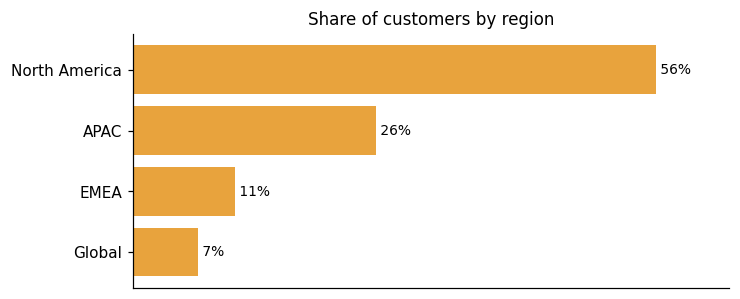
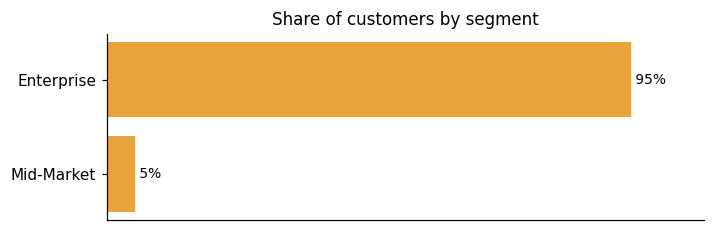
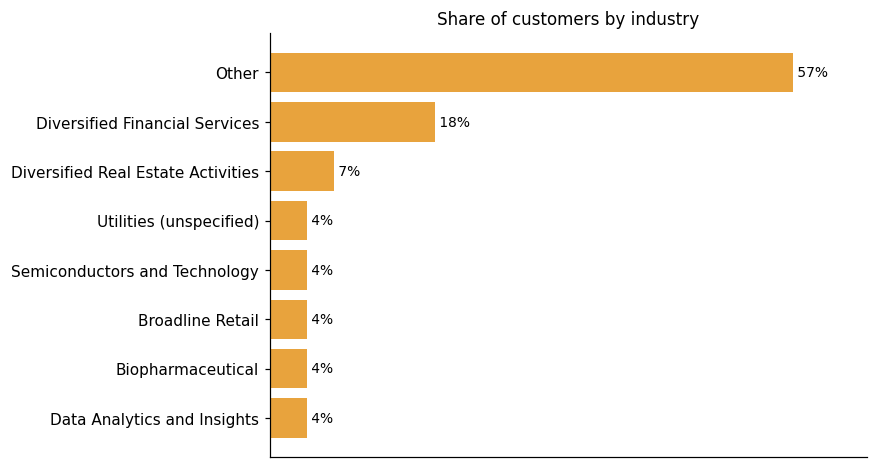
Representative customers: 84.51˚, Alkermes, Allegro, AMD, Australian energy supplier, Avista, Daimler Trucks North America
How Alation Agentic Data Intelligence Platform uses AI in practice
The Alation Agentic Data Intelligence Platform is built around AI as its primary function, applying it across documentation, data quality, curation, policy enforcement, and natural-language querying. AI is not a layer added on top — removing it would eliminate the platform's core value. The ALLIE AI layer builds upon Alation's machine learning core, and saves time and scales data initiatives, democratizes trusted data, and advances new AI initiatives across the organization. Agentic workflows handle the operational work directly: automating documentation, enforcing policies, and streamlining data product delivery so teams can focus on building AI and analytics.
Agentic AI
Read detailsAlation Agentic Data Intelligence Platform runs purpose-built AI agents across four specific workflows: metadata curation, data quality rule generation, CDE governance, and natural-language data querying. The vendor states that these agents execute those tasks autonomously, grounded in a governed knowledge layer. They are deployable via MCP or REST APIs.
Generative AI
Read detailsAlation Agentic Data Intelligence Platform applies generative AI across three areas: producing human-readable metadata descriptions, answering business questions in plain English by generating SQL or Python behind the scenes, and powering conversational interfaces across data products and analytics.
Recommendation / Matching
Read detailsThe Alation Agentic Data Intelligence Platform applies its ML core to both search and catalog curation across semantic understanding, behavioral signals, and context-aware recommendations. When a user types a natural language query, the ML engine interprets the intent and surfaces the most relevant trusted data assets rather than returning raw keyword matches. Usage patterns inform what gets recommended next: metadata descriptions, data products, and steward assignments are all suggested based on how the catalog is actually being used and what context already exists within it.
Anomaly / Pattern Detection
Read detailsThe Alation Agentic Data Intelligence Platform centers its anomaly and pattern detection on a Behavior Analysis Engine. This engine analyzes query patterns and usage signals to identify which data assets have the highest impact, then prioritizes those assets for quality monitoring. From there, it automatically suggests tailored rules for anomaly detection and data validation — rules shaped by the specific query patterns and usage signals already observed.
Predictive ML
Read detailsAlation Agentic Data Intelligence Platform ranks search results and catalog recommendations using an ML core that learns from actual user behavior and usage patterns. As interactions accumulate, the model continuously refines both relevance rankings and curation suggestions.
Alation Agentic Data Intelligence Platform pricing and value: quote-based costs, ROI and fit
Alation Agentic Data Intelligence Platform does not publish list prices — all pricing is available through a direct quote request. Customer evidence, though, makes the platform's practical impact concrete. Individual users report a 24-minute weekly time savings per person. At larger scale, those gains compound: Discover reached 200,000 hours saved. As one customer puts it, By improving the speed at which we are able to acquire and use data, we can turn that saved time into product innovations that help us remain No. 1 in customer satisfaction and delivering personalized customer experiences. Cloud migration is a second area where customers see step-change results. One customer notes that their migration to GCP would have been almost impossible, or taken ten times as long without Alation.
ROI evidence from 5 customers
- Users report a 24-minute weekly time savings
- By improving the speed at which we are able to acquire and use data, we can turn that saved time into product innovations that help us remain No. 1 in customer satisfaction and delivering personalized customer experiences.
- The productivity gains and faster time to insights lead to more time for innovation – and in Discover's case, that equates to 200,000 hours saved.
- 200,000 hours saved
Who it fits: value by company size
The Alation Agentic Data Intelligence Platform draws customers across all company sizes, from under 1,000 employees to 10,000 and above, as reflected in its company size range. One signal of what drives adoption at scale: as Oportun puts it, "as we grew, we realized we needed to capture all of the institutional knowledge of our people in a centrally available enterprise metadata repository." The platform handles significant data volumes — one customer has 250+ enterprise data lakehouse tables cataloged and monitored. Ease of adoption matters too: one customer notes, "with Alation, everything was focused on the simplicity of the user interface — it was something that we knew we wouldn't have a hard time getting adoption for across the enterprise." On pricing, there is a known friction point worth flagging. Some buyers find the on-premise license model carries too many add-ons, and the preference expressed is to pay one price and get all features. Teams with tight or fixed budgets should probe the total cost of the configuration they need before committing.
Alation's pricing page publishes no specific prices and routes all visitors to a 'Request Pricing' form to get a quote.
Alation Agentic Data Intelligence Platform enterprise readiness: security, compliance, migration, and support
Alation Agentic Data Intelligence Platform addresses enterprise readiness across four dimensions: security, compliance, migration, and customer support. These dimensions span Alation's coverage of Data Governance Solutions and Data and Analytics Governance Platforms.
Security controls and assurance
The Alation Agentic Data Intelligence Platform is built on a layered security foundation. It holds ISO 27001:2013 and ISO 27701:2019 certifications alongside a SOC 2 Type II attestation — the combination covering information security management and privacy information management together. Data is protected at rest and in transit using industry-standard encryption protocols. Role-based access control integrates with customer-owned multi-factor authentication systems, keeping sensitive data accessible only to entitled personnel. For public-sector buyers, FedRAMP Moderate authorization is currently in process, meaning government agencies and organizations with high-security requirements should factor that timing into their evaluation.
Compliance and data protection
The Alation Agentic Data Intelligence Platform approaches compliance across both privacy frameworks and recognized standards. On the privacy side, the platform's data privacy program covers GDPR and CCPA, honoring user rights including the ability to access, correct, or delete information. The platform also complies with HIPAA/HITECH. For organizations with data sovereignty requirements, data residency options let customers store data in specific regions to meet local legal obligations. On the standards side, the platform holds SOC II Type 2 and treats it as a continuously maintained commitment rather than a one-time exercise. That posture aligns with a broader recognition that regulatory expectations now require provable, continuous compliance rather than periodic attestations. One structural risk the platform is designed to address is metadata quality. Incomplete or inconsistent metadata is a documented blocker for regulatory compliance programs, leaving governance gaps undetected and increasing risk exposure. Buyers should weigh how well their current metadata practices would hold up under that standard before deployment.
Migration from competing platforms
Cloud migrations routinely run over schedule — most migrations don't complete within the required timeframes. A core challenge is simply knowing what to move: knowing what data to migrate and ensuring everyone in the organization can self-service trusted data in the data lake is challenging. Alation Agentic Data Intelligence Platform addresses this by surfacing intelligence about legacy assets, helping teams speed up migration by spotlighting the most critical assets to move to the AWS environment. For Databricks-bound migrations, it adds a layer of guidance — providing visibility and intelligence across all your legacy data assets and workloads to prioritize migration and ensure success. It also works to keep users oriented after the move, eliminating the uncertainty in data migration by providing visibility to the migration process, prioritizing the most used data, and guiding users to new data in Databricks.
Customer support experience
Alation Agentic Data Intelligence Platform combines structured onboarding with a global support network, though customers flag meaningful gaps alongside the strengths. The Right Start program connects implementation to business strategy from day one. A follow-the-sun support network is designed to serve enterprise organizations across regions. Self-service resources round out the offering: in one customer's words, they have a bunch of learning material and documentation, especially Alation Community where you can find solutions to problems. Not everything lands well, however. Customers flag that data mapping can be confusing, and separately that support service needs improvement.
Alation Agentic Data Intelligence Platform vs. Collibra, IBM, Informatica and other platforms
Data and analytics governance platforms give business leaders and users the tools to set, monitor, and enforce governance policies across their organization's systems — distinct from data management, which focuses on executing those policies rather than defining them. The Alation Agentic Data Intelligence Platform competes in this category across four areas: data catalog, data lineage, analytics, and data governance policy management. Its catalog centralizes assets from 120+ sources with natural-language search, AI-driven discovery, and user-augmented curation. Lineage is traced end-to-end through automated metadata extraction, SQL log analysis, and a proprietary query-parsing engine that follows data from source to destination. Alation Analytics adds a natural-language interface for querying governance data itself, tracking maturity metrics, platform adoption, ROI, and asset curation. Governance policies are centralized with automated stewardship workflows linked to enforcement controls across governed assets. The comparison that follows highlights where Alation, Collibra, IBM, and Informatica differ — it covers selected dimensions where the vendors diverge, not every feature in the category. Where Alation trails peers on specific dimensions, those differences are visible in the ratings table rather than obscured here.
Data and Analytics Governance Platforms
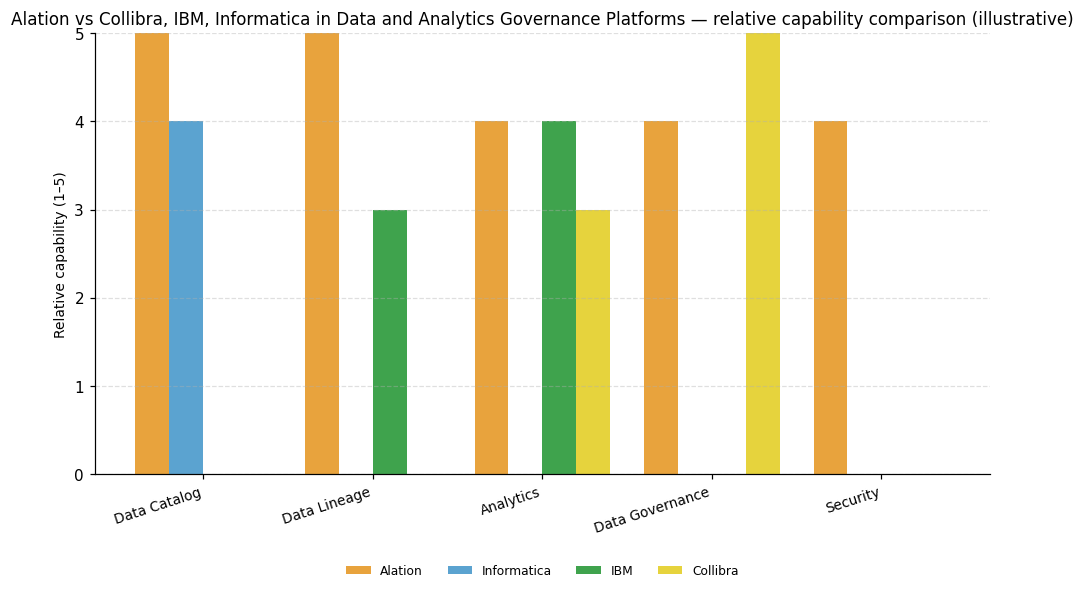
| Capability | Alation | Collibra | IBM | Informatica |
|---|---|---|---|---|
| Data Catalog | 5 | — | — | 4 |
| Data Lineage | 5 | — | 3 | — |
| Analytics | 4 | 3 | 4 | — |
| Data Governance | 4 | 5 | — | — |
| Security | 4 | — | — | — |
Alation
Data Catalog: Metadata-driven catalog centralizes assets from 120+ sources with natural-language search, AI-driven discovery, and user-augmented curation.; Data Lineage: End-to-end lineage combining automated metadata extraction, SQL log analysis, and a proprietary query-parsing engine to trace data from source to destination.; Analytics: Alation Analytics tracks data maturity metrics, platform adoption, ROI, and asset curation with a natural-language interface for querying governance data.; Data Governance: Platform centralizes governance policies with automated stewardship workflows and links to enforcement controls across governed assets.; Security: Platform holds ISO 27001:2013, ISO 27701:2019, SOC 2 Type II, and HIPAA/HITECH certifications covering operational and product security for enterprise customers.
Collibra
Data Governance: Provides end-to-end governance vision covering various use cases including AI governance with dedicated policy representation capabilities.
IBM
Analytics: watsonx.governance adds AI model governance with knowledge-graph visualization and ontology mappings as emerging capabilities.
Informatica
Data Catalog: Comprehensive data cataloging integrated within IDMC alongside data quality, MDM, and data integration capabilities.



Connect Alation Agentic Data Intelligence Platform with your stack: integrations and partner ecosystem
Alation Agentic Data Intelligence Platform connects to a broad range of external tools through 18 native integrations and 7 integration partnerships spanning 19 partner categories. Those categories reach across cloud data platforms, CRM systems, and team collaboration tools, among others.
The Alation Agentic Data Intelligence Platform is built to fit into an existing technology stack rather than replace it. It connects to 100+ data sources, including warehouses like Snowflake and Databricks and BI tools like Tableau and Power BI. Teams embed it into apps and workflows through MCP or REST APIs. Alation APIs let companies integrate their own applications and systems into the platform, which acts as a central repository for finding, understanding, and trusting data. The architecture combines native connectors with APIs to reach existing data ecosystems. It supports both on-premises and multi-cloud deployments, with Azure as one documented multi-cloud environment. The design is vendor-neutral, so governed metadata flows into the tools and workflows a team already uses.
| Partner category | Integration partners | Native count | Flow direction |
|---|---|---|---|
| cloud data platform | Snowflake | 1 | Bidirectional |
| CRM | Salesforce | 1 | Bidirectional |
| team collaboration | Microsoft Teams, Slack | 2 | Downstream |
| business intelligence | Tableau, Looker | 2 | Bidirectional |
| project management | Jira | 1 | Bidirectional |
| IT service management | ServiceNow | 1 | Bidirectional |
| analytics automation | Alteryx | 0 | Bidirectional |
| cloud platform | Amazon Web Services | 1 | Bidirectional |
| data access control | Immuta | 1 | Bidirectional |
| data connector development | Information Asset, Logan Data | 0 | Upstream |
| data lakehouse platform | Databricks | 1 | Bidirectional |
| data management | IBM Data Product Hub, SAP Datasphere | 0 | Bidirectional |
| data observability | Acceldata | 0 | Upstream |
| data optimization | Spreems | 0 | Upstream |
| data pipeline | Fivetran | 1 | Upstream |
| data privacy and security | BigID | 1 | Bidirectional |
| data quality | Anomalo | 1 | Upstream |
| relational database | MySQL, Oracle, PostgreSQL | 3 | Upstream |
| web browser | Google Chrome | 1 | Downstream |
What's new in Alation Agentic Data Intelligence Platform
Alation Agentic Data Intelligence Platform has shipped 3 product updates in the last 9 months, spanning both the Data Governance Solutions and Data and Analytics Governance Platforms categories. Over that same period, Alation made 1 partnership or integration announcement. The platform has also earned 3 awards over the past 24 months.
Alation Ends the Era of Manual Data Governance
Alation has built an agent-powered operating system designed to replace human-run governance workflows with automated, outcome-based ones. The general availability of Alation Curation Automation completes this system, automating metadata governance at scale within the Alation Agentic Data Intelligence Platform.
Read more →Introducing a Critical Data Element Manager to Deliver Agentic Governance for Business-Critical Data
Alation recently unveiled a new module for the Alation Agentic Data Intelligence Platform focused on governing Critical Data Elements at scale. Called CDE Manager, it is a dedicated solution designed to bring business, risk, and data teams together around a shared set of standards for high-priority data. The platform uses purpose-built AI agents to translate policy intent into actionable standards and to continuously monitor compliance. Alation positions this approach as "agentic governance," with the vendor describing the AI agents as capable of carrying policy intent through to enforceable standards without requiring manual intervention at each step. The overall goal is to let organizations govern data based on the specific business outcomes they want to achieve, rather than managing governance as a purely technical exercise.
Read more →Alation Announces Agent Builder To Deliver Enterprise-Grade AI Agents for Structured Data
Alation announced Agent Builder, a next-generation AI platform that lets enterprises build, manage, and deploy metadata-aware, configurable AI agents for structured data. These agents are designed to be production-ready and deliver dramatically higher levels of accuracy. The platform gives organizations the ability to bring AI agents to life within the broader Alation Agentic Data Intelligence Platform.
Read more →Recent awards for Alation Agentic Data Intelligence Platform
The Alation Agentic Data Intelligence Platform has received 3 awards in the last 24 months, spanning workplace recognition, a community award, and analyst recognition. Those awards include the 2025 Data Radicals Awards and five-time Leader status in the Gartner Magic Quadrant for Metadata Management Solutions.
- 2025 Data Radicals Awards (2025-11-13) →
- Gartner Magic Quadrant for Metadata Management Solutions — Leader (5x) (2025-11-21) →
- Leader in the Gartner Magic Quadrant for Metadata Management Solutions (5x) (2025-11-19) →
Alation CEO Warns That Smarter AI Agents Can Still Get Your Business Wrong
Alation announced six new or expanded products for its Alation Intelligence Operating System (AIOS) at the revAlation conference. These products aim to enhance AI agents' reliability through data governance and semantic model mastering. Alation's AI Governance integrates with platforms like Snowflake and Databricks, providing a shared registry and risk assessment for AI agents. The company emphasizes the importance of consistent business definitions and human oversight in AI decision-making.
Alation Launches AIOSâ„¢ Expansion with Six Products that Accelerate AI Transformation
Alation has expanded its AIOS platform with six new products designed to enhance data governance and AI compliance. These products include AI Governance, Ontologies, Intelligent Feeds, Console, Governed Collections, and Semantic Model Mastering. They aim to improve data context and governance across enterprise systems, supporting AI-driven decision-making and regulatory compliance.
Alation Data Intelligence and AIOS: How Deep Does the AI Governance Ecosystem Really Go? - cxtoday.com
Alation has launched AIOS, an architecture that integrates its data intelligence platform with AI governance capabilities. AIOS connects Alation's catalog, lineage, data quality, and semantic context, offering integration with platforms like Salesforce, Snowflake, and Databricks. This integration aims to enhance AI governance and customer data workflows by ensuring consistent context and lineage across systems.
Alation Profile
Company Name
Alation
Company Website
https://www.alation.com/HQ Location
3 Lagoon Dr, #300 Redwood City, CA 94065
Employees
101-250
Social


Financials
SERIES C